

Charleston's Luxury Market Is Playing by Its Own Rules This Summer
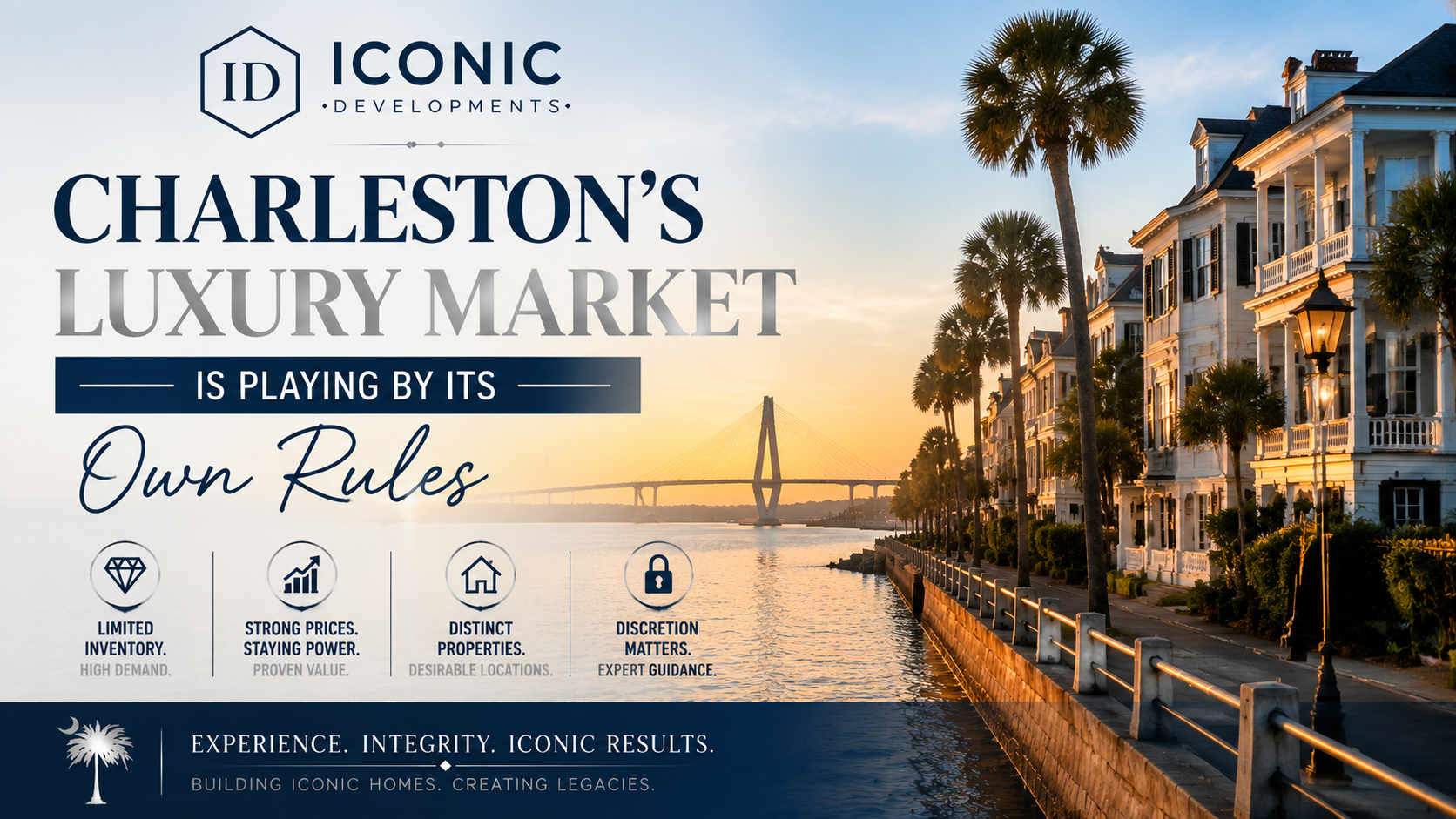
If you own a home on Isle of Palms or Sullivan's Island, you've probably heard the same national headlines everyone else has: the housing market is cooling, starter homes are sitting, and buyers are gaining leverage. Then you look at what's actually trading on the barrier islands — a $13 million sale on Isle of Palms, a $6 million contract on Sullivan's Island, luxury inventory moving while mid-market listings linger — and the headlines stop making sense.
Here's the reality: America's housing market has split in two, and Charleston is one of the clearest examples of it. The broader market is rate-sensitive, inventory-heavy, and negotiable. The luxury market — roughly $2 million and up here in the Lowcountry — is running on a different engine entirely: equity, cash, stock market gains, and a generational wealth transfer that is putting well-capitalized buyers on planes to Charleston every week.
Whether you're a seller trying to price a waterfront property correctly, a buyer wondering if waiting for lower rates makes sense, or an investor comparing Charleston to other coastal markets, understanding this two-speed dynamic is the single most useful lens for the second half of 2026. Let's break down what's driving it and how to position yourself.
Market Insight: The Fed Held, and the High End Didn't Blink
The Federal Reserve wrapped up its July meeting yesterday and left rates unchanged at 3.5%–3.75% — but with a notable twist: three members dissented in favor of a rate hike, and markets now put the odds of a September increase at roughly 50/50. The 30-year fixed mortgage is sitting around 6.6% this week, essentially where it's been all month.
In plain terms: anyone waiting for meaningfully cheaper financing this fall may be waiting for something that isn't coming. If anything, the risk has shifted toward rates ticking up, not down.
Meanwhile, the national data tells a striking story about the top of the market. Luxury home prices are rising nearly five times faster than non-luxury prices, and the typical luxury home now sells for about 3.6 times the price of a typical home — roughly $1.9 million nationally. Pending luxury sales are up 5.2% year over year, the strongest gain since late 2024, while starter homes pile up in many metros. An estimated $6 trillion in wealth changed hands globally in 2025 alone, and a meaningful share of those inheritance-fueled buyers are paying cash — which is exactly why a 6.6% mortgage rate barely registers at the top of the market.
Charleston's numbers confirm the split locally. Per CTAR data, luxury transactions in the tri-county area rose 12.1% through May, with the median luxury price climbing 7.8% to $1.4 million. In a single early-July week, 37 single-family homes listed at $1 million or more went under contract — over 15% of all single-family activity — and 32 of them were on the islands and master-planned coastal communities.
Why the Luxury Market Decouples: A Practical Explanation
This isn't magic, and it isn't a bubble. Four structural forces explain why Charleston's high end keeps outperforming:
1. Cash removes rate sensitivity
When a buyer isn't financing — or is financing strategically with plans to recast later — the Fed's decisions are background noise. A large share of barrier island purchases close in cash, which means the segment simply doesn't slow down when rates hold at 6.6%.
2. Coastal land is genuinely finite
Sullivan's Island has roughly 32 homes on the market at any given time in a community that essentially cannot add supply. Isle of Palms has more inventory — about 124 homes, with a median list price around $2.07 million — but buildable oceanfront and deep-water lots are not being manufactured. Scarcity is the most durable price support in real estate, and Charleston's islands have it structurally.
3. Replacement cost keeps rising
As a builder, I watch this one closely. Elevated coastal construction — pilings, flood-zone compliance, wind-rated assemblies, impact glazing — continues to get more expensive, not less. When it costs $500–$700+ per square foot to replace a quality elevated home on the islands, existing homes are repriced upward to match. Insurance costs are real, but for the luxury buyer they're a line item, not a dealbreaker.
4. Equity and portfolio wealth
Strong equity markets have expanded purchasing power at the top of the income spectrum. Many of our buyers are arriving from the Northeast, Midwest, and West Coast having sold appreciated homes or trimmed appreciated portfolios. Their decision driver is lifestyle and timing — not the mortgage rate. See our guide for relocating purchasers: what out-of-state buyers get wrong before they buy.
Buyer and Seller Strategy: What to Do Right Now
If you're buying at $2M+ in Charleston
Stop waiting on the Fed. With September hike odds near a coin flip, the "rates will save me" strategy has flipped. If the property is right, the cost of waiting on the islands has historically been price appreciation, not savings.
Hunt where days-on-market are long. Sullivan's Island listings are averaging around 80 days on market. That's not weakness — it's a thin, patient market — but a home sitting past 90–120 days often has a pricing story, and that's your negotiation opening.
Use cash as leverage, then finance later. Cash offers win on the islands. If you'd rather stay invested, close in cash and put a mortgage on afterward — delayed financing preserves both your negotiating position and your portfolio.
Underwrite insurance and elevation before you offer. Get the elevation certificate, wind/hail and flood quotes, and any FEMA compliance issues on the table during due diligence — not after. On older, lower-elevation homes this can move real money.
If you're selling a luxury property
Price to the luxury comps, not the county trend. The mid-market and the high end are moving in opposite directions. A seller who prices a $3 million Isle of Palms home off broad "Charleston is cooling" data will underprice; one who anchors to stale 2024 records may overshoot. The right comp set is narrow, recent, and island-specific.
Presentation is non-negotiable at this tier. Cash buyers flying in for a weekend see three to five properties. Professional staging, twilight photography, video, and a property that shows turnkey are the price of admission — luxury buyers at this level are buying a finished lifestyle, not a project.
Expect a longer runway and plan for it. Eighty days on market is normal for the high end. Build your carry costs and timing into the plan rather than chasing the market down with reactive price cuts. More on what to do when your Charleston home isn’t selling.
Local Market Context: Where the Money Is Moving
The current numbers across Charleston's luxury submarkets sketch the map clearly. Sullivan's Island remains the scarcity play, with median list prices around $4.5–$4.8 million and barely 30 homes available. Isle of Palms offers the widest luxury range — roughly $1.5 million to $8 million-plus for single-family homes, with resort condos providing an entry point below $1 million and strong rental income potential. Daniel Island has matured into a seven-figure primary-residence community, with median sales around $1.7–$1.8 million and steadier year-round demand than the seasonal beach markets. Downtown Charleston's historic district continues to attract national buyers who want walkability and architecture that cannot be replicated.
On the supply side, the new construction pipeline at the high end remains thin. Buildable island lots are scarce, entitlement and permitting timelines on the coast run long, and elevated construction costs mean spec builders are selective. That keeps finished new construction commanding a premium — and it's why well-executed custom builds on good lots have been some of the strongest-performing assets in the region. Here’s what it costs to build a custom home in Charleston in 2026.
For investors, the short-term rental math on Isle of Palms continues to benefit from the island's rental-friendly framework relative to neighboring municipalities, though underwriting should assume today's insurance premiums and conservative occupancy. Here’s the full Isle of Palms short-term rental investment analysis.
Frequently Asked Questions
Is the Charleston luxury real estate market slowing down in 2026?
No. While the broader market has cooled, Charleston's luxury segment is accelerating — CTAR data shows luxury transactions up 12.1% through May 2026, with the median luxury price up 7.8% to $1.4 million. The high end is behaving very differently from the mid-market.
What did the Fed's July 2026 decision mean for mortgage rates?
The Fed held its target range at 3.5%–3.75% on July 29, but three members voted for a hike and markets price roughly 50/50 odds of an increase in September. The 30-year fixed is holding near 6.6%, and near-term relief looks unlikely.
How much does a home cost on Sullivan's Island vs. Isle of Palms?
Sullivan's Island median list prices are running around $4.5–$4.8 million with about 32 homes available. Isle of Palms is broader: median list around $2.07 million, single-family homes from $1.5 million to $8 million-plus, and condos from the mid-$300s.
Should I wait for lower interest rates to buy a luxury home in Charleston?
The waiting math has weakened. Rates are more likely to hold or rise near-term than fall, and luxury prices in Charleston are appreciating faster than borrowing costs are likely to drop. If the property fits, negotiating well today generally beats waiting for cheaper money.
Do most luxury buyers in Charleston pay cash?
A large share do, particularly on the barrier islands — driven by home equity, portfolio gains, and inherited wealth. Cash is also a competitive tool: many buyers close in cash for leverage, then add financing afterward.
Is a luxury home in Charleston a good investment in 2026?
The structural case is strong: finite coastal land, rising replacement costs, in-migration of high-income households, and thin new construction supply. The keys are buying the right location and elevation, underwriting insurance honestly, and holding through cycles.
Let's Talk About Your Move
Looking to buy, build, or invest in Charleston real estate? I'm Chris Eller, Broker Associate with The Cassina Group and a luxury real estate developer specializing in new construction and coastal properties across Charleston and the barrier islands. Call/Text: 843-343-3359 | Email: Chris@TheCassinaGroup.com | Website: ChrisEllerRealEstate.com. If you're considering buying, selling, or building in Charleston or anywhere in the Lowcountry, reach out anytime for expert guidance.