

The 1031 Exchange Math Charleston Investors Are Running Before They Sell in 2026
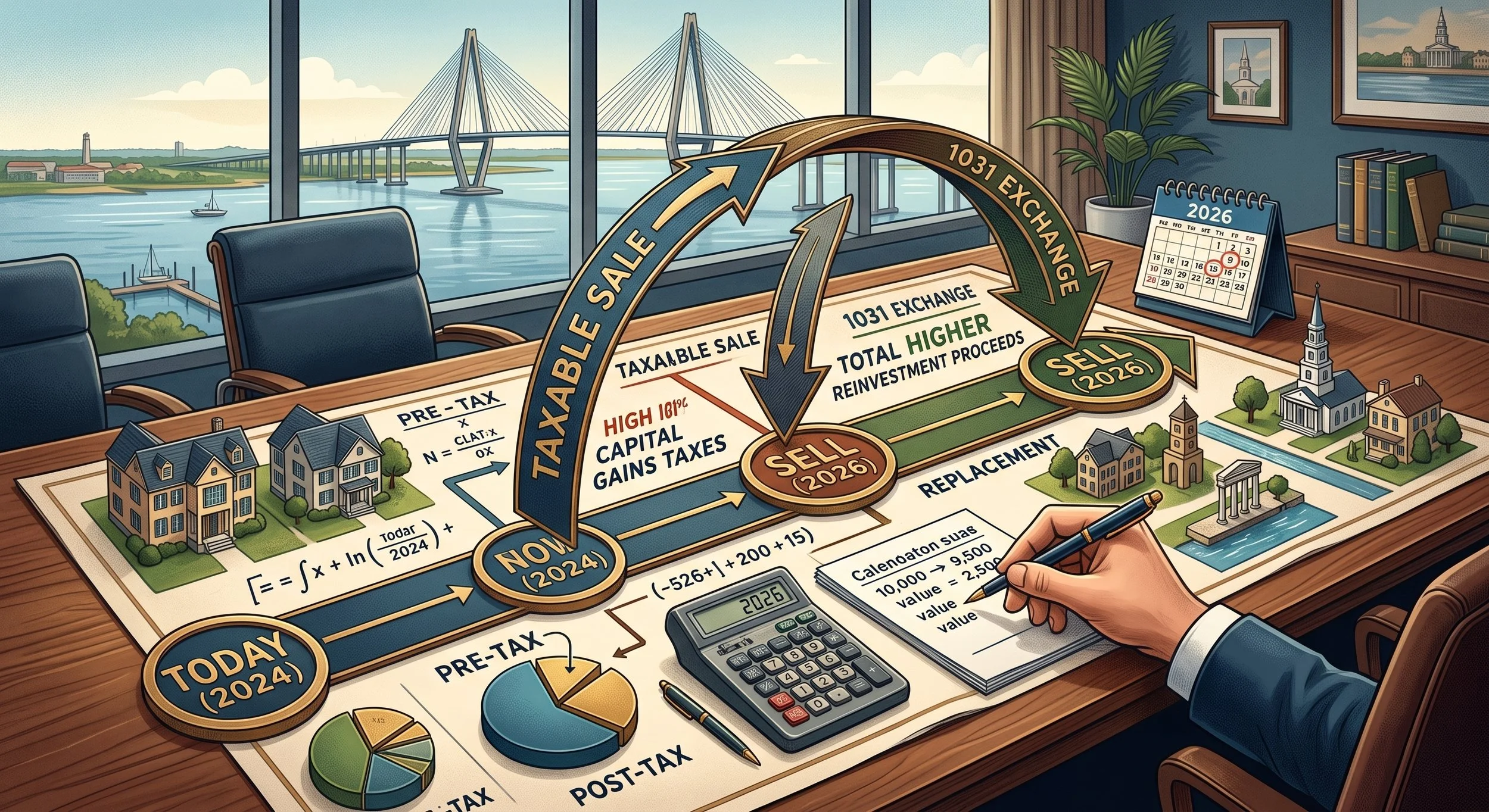
There is a specific conversation happening across Mount Pleasant, James Island, and the barrier islands this summer, and it almost always starts the same way: an owner bought a rental somewhere between 2015 and 2020, the property has appreciated substantially, the tenant situation has become a headache, and they want out. Then their accountant runs the numbers on what a straight sale actually costs them, and the conversation stops cold.
The problem isn't the sale price. Charleston pricing has held up — the metro median sits near $625,000, up roughly 2.8% year over year, and Charleston County's median list price ran about $718,750 in July. The problem is the stack of taxes waiting on the back end of a long hold: federal capital gains, a 25% federal rate on depreciation recapture, the 3.8% net investment income tax for higher earners, and South Carolina on top of that. On a property held ten-plus years, recapture alone routinely adds $30,000 to $50,000 or more to the bill.
That is why the 1031 exchange has become the default question here rather than an advanced strategy. Below is how the math actually works in Charleston right now, what the deadlines look like in practice, and where investors are redeploying capital.
What the 2026 Numbers Actually Say
Three data points shape every exchange decision being made in Charleston this month.
Financing is stable, not falling. Freddie Mac's 30-year fixed averaged 6.67% in its August 13 survey, down two basis points from 6.69% the week prior and up from 6.58% a year ago. That flatness matters more than the level. An investor who sells today and needs to close a replacement property inside 180 days is not making a bet on a dramatic rate drop — they're underwriting near current cost of capital. Investment-property financing typically prices above that headline, and debt-service-coverage products price higher still.
The market is balanced, which cuts both ways. Charleston is carrying roughly 3.56 months of supply, with homes going under contract in about 53 days and selling near 97.6% of asking. For a seller, that's a functional, predictable exit. For the same person turning around as a 1031 buyer on a 45-day clock, that same balance means real competition on well-priced replacement inventory — you are not the only person shopping with a deadline.
The rental picture has split. Multifamily and apartment rents in Mount Pleasant have flattened, averaging around $2,264 and down about 1% year over year as new apartment supply delivers. Single-family rentals have moved the other direction, with Mount Pleasant single-family rent growth reported near 10.4% year over year. That divergence is the single most useful signal in this market: the replacement asset class matters more than the replacement address.
How a 1031 Exchange Works — The Rules That Actually Break Deals
Section 1031 lets an investor defer federal capital gains and depreciation recapture by exchanging investment or business-use real property for other investment or business-use real property. It is a deferral, not forgiveness. Two clocks govern it, and they are the reason most failed exchanges fail.
The 45-day identification window
From the day your relinquished property closes, you have 45 calendar days to deliver written identification of your replacement property to your qualified intermediary. Weekends and holidays count. There are three identification methods: the three-property rule (up to three properties of any value, which most investors use), the 200% rule (unlimited properties whose combined value can't exceed 200% of what you sold), and the 95% rule (unlimited properties, but you must close on at least 95% of identified value).
The 180-day closing window
You have 180 calendar days from the same closing date to acquire the replacement property — or your tax return due date including extensions, whichever comes first. Critically, these windows run concurrently, not back to back. Once day 45 passes, you have 135 days left, not 180.
The mechanics that trip up Charleston sellers
The qualified intermediary must be engaged before closing. If sale proceeds touch your account, the exchange is dead. This gets missed on quick cash closings.
Debt must be replaced, not just equity. Trading a property with a $400,000 mortgage into an all-cash purchase creates taxable boot unless you add cash or new debt.
Primary residences and flips don't qualify. Property held primarily for resale is inventory, not investment. Charleston has a lot of renovate-and-resell activity that owners incorrectly assume is exchangeable.
Short-term rentals need genuine investment intent. Heavy personal use of a beach property invites scrutiny.
One Charleston-specific note on timing: coastal transactions here carry due diligence variables inland markets don't — elevation certificates, flood zone determination, wind and hail coverage binding, dock permit status on marsh-front parcels, septic-to-sewer questions on parts of Johns and Wadmalaw. Each can add two to three weeks. On a 45-day clock, that's not a detail.
Investor Strategy: Where the Capital Is Going
The strongest 1031 positions in Charleston right now share a pattern — they trade management intensity for durable demand, and they use the tax code twice.
Reverse the sequence when inventory is thin. A reverse exchange — where an exchange accommodation titleholder acquires the replacement property before you sell — costs more and requires financing that permits it, but it removes the single biggest failure risk. Anyone trading into a specific, hard-to-replace asset should price this option before listing.
Stack a cost segregation study on the replacement property. This is the piece most Charleston investors leave on the table. The One Big Beautiful Bill Act permanently restored 100% bonus depreciation for qualified property acquired and placed in service after January 19, 2025 — no phasedown, no sunset. Residential structure still depreciates over 27.5 years, but a cost segregation study separates out the five-, seven-, and fifteen-year components — appliances, cabinetry, flooring, site work, landscaping, dock and hardscape improvements — which are bonus-eligible. Identify $150,000 of qualifying components and that deduction lands in year one.
Trade multifamily exposure for single-family. Given flat apartment rents against double-digit single-family rent growth in Mount Pleasant, investors exiting small multifamily into well-located single-family or attached product are moving toward the stronger rent trend and a broader eventual buyer pool.
Underwrite insurance before you identify. Wind, hail, and flood premiums on barrier island and marsh-front property have moved enough to change cap rates outright. Get a real quote inside the identification window.
If you're weighing which submarket to redeploy into, the underwriting differs meaningfully by island — the Isle of Palms investment numbers and the James Island rental math break down very differently, and short-term rental rules on Isle of Palms and Sullivan's Island should be confirmed before a property is identified, not after.
Charleston Market Context: What Qualifies as a Real Replacement
Charleston's investment inventory is not uniform, and exchange buyers with a hard deadline need to know where qualifying product actually clears.
Mount Pleasant carries the deepest single-family rental demand in the metro, driven by proximity to the Ravenel Bridge, the medical district, and the barrier islands. It is also the most competitive place to close inside 45 days, which argues for identifying backups under the three-property rule.
Daniel Island and the Cainhoy peninsula represent the largest active new-construction pipeline in the region. New delivery is where cost segregation pays best — the component basis is cleanest on a property that hasn't been through a decade of undocumented improvements.
Downtown Charleston historic income property carries the tightest renovation constraints under Board of Architectural Review oversight. Strong long-term basis, wrong asset to identify with the clock already running.
Berkeley County and the northern growth corridor remain the entry point for investors trading down in price and up in unit count. Land and lot inventory north of the Cooper is where a meaningful share of 1031 proceeds has been redeployed over the past eighteen months — the Berkeley County land picture covers what that acquisition actually looks like.
One structural advantage worth naming: South Carolina allows a 44% deduction on long-term capital gains under S.C. Code Ann. § 12-6-1150, which brings the effective state rate to roughly 3.36%. That softens the state-level hit on a taxable sale — but it does nothing for the 25% federal recapture, which is usually the larger number.
Frequently Asked Questions
How long do I have to complete a 1031 exchange?
45 calendar days from your sale closing to deliver written identification of replacement property to your qualified intermediary, and 180 calendar days total to close. The two periods run at the same time, and the IRS does not extend them for weekends, holidays, or ordinary delays.
Can I 1031 exchange a short-term rental in Charleston?
Generally yes, if it is genuinely held for investment rather than personal enjoyment. The IRS safe harbor guidance looks at rental days versus personal-use days over the preceding two twelve-month periods. Heavy owner use of a beach property is the most common disqualifier on Isle of Palms and Sullivan's Island exchanges.
What happens if I miss the 45-day deadline?
The exchange fails and the entire gain becomes taxable in the year of sale, including depreciation recapture. There is no partial credit and no extension absent a federally declared disaster affecting your property. This is the single most common reason Charleston exchanges collapse.
Do I have to buy something more expensive than what I sold?
To defer the full gain, yes — replacement value, equity, and debt all need to be equal or greater. Buy down in value or reduce debt without adding cash and the difference becomes taxable boot. Partial exchanges are permitted; they're just partially taxed.
Can I 1031 exchange into raw land in Berkeley County?
Land held for investment qualifies. The complication is that unimproved land generates no depreciation, so you defer the gain but lose the shelter going forward. Investors targeting land typically pair it with a build strategy rather than treating it as the endpoint.
Is a 1031 exchange worth it if my gain is small?
Qualified intermediary fees generally run in the low thousands. If your combined deferral is under roughly $15,000–$20,000, sometimes paying the tax and buying freely on a normal timeline is the better business decision.
None of the above is tax advice. Exchange structure, basis, and recapture calculations should be confirmed with your CPA and a qualified intermediary before you list.
Let's Talk About Your Charleston Investment Property
Looking to buy, build, or invest in Charleston real estate? I'm Chris Eller, Broker Associate with The Cassina Group and a luxury real estate developer specializing in new construction and coastal properties across Charleston and the barrier islands.
Call/Text: 843-343-3359 | Email: Chris@TheCassinaGroup.com | Website: ChrisEllerRealEstate.com
If you're considering buying, selling, or building in Charleston or anywhere in the Lowcountry, reach out anytime for expert guidance.
