

Rates Went Up Again — But Charleston Buyers Have More Leverage Than They've Had Since 2019
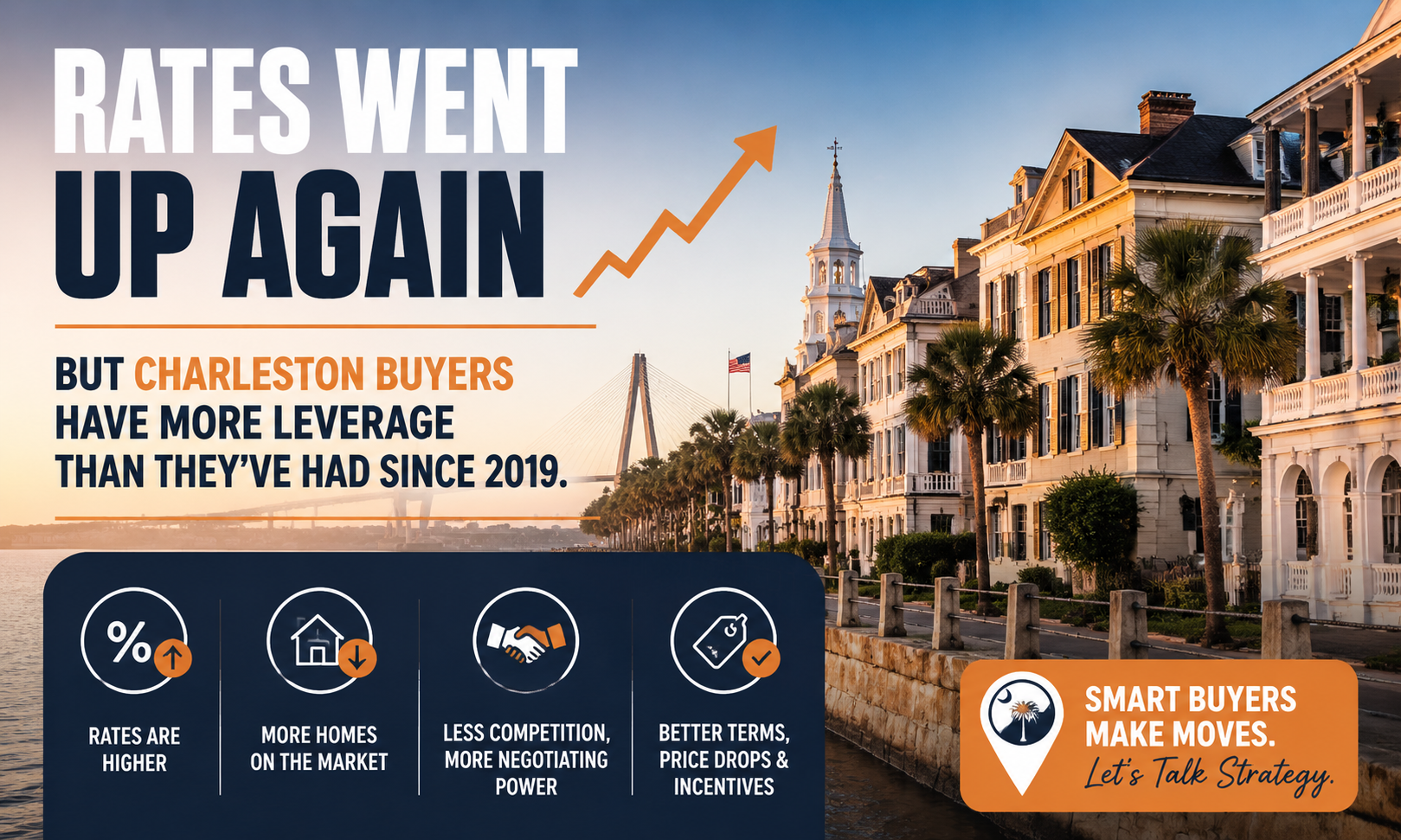
Every week I get some version of the same phone call. A buyer has been circling a house in Mount Pleasant or on Sullivan's Island since spring. They love it. Their lender quoted them the mid-sixes. Then Thursday's rate headline lands a little worse than last week, and they call to ask whether they should wait.
Here's what I tell them, and it surprises people: the rate is the loudest number in the transaction and usually the least negotiable one. The price, the closing costs, the repair credits, the builder's incentive package, the seller's willingness to buy your rate down — those are all negotiable, and right now in Charleston they're negotiable in a way they simply were not two or three years ago.
The buyers getting hurt this summer aren't the ones paying 6.6%. They're the ones who spent four months waiting for a rate that never came and watched three good houses go under contract. Let's walk through where rates actually are, what the Charleston market looks like underneath the national noise, and how I'd play it this month.
Where Mortgage Rates Actually Stand Right Now
Freddie Mac's weekly survey put the 30-year fixed at 6.66% for the week ending July 30, 2026, up from 6.58% the week before. Daily trackers had it near 6.65% to open August, with the 15-year fixed closer to 5.95%.
Two things worth noting. First, we're roughly flat year-over-year — a year ago the same survey read 6.72%. Rates have chopped sideways in a narrow band for twelve months. Second, the recent drift upward isn't a Fed story. The Fed held at 3.50–3.75% on July 29, its fifth consecutive hold. Mortgage rates follow the 10-year Treasury, which follows inflation expectations — and inflation has been stickier than anyone wanted.
Two data points in the next ten days will set the tone: the jobs report on August 7 and the CPI print on August 12. A soft jobs number or cool inflation reading pulls mortgage rates down. A hot one pushes us toward 7%. Longer term, Fannie Mae has the 30-year near 6.4% through year-end and the Mortgage Bankers Association has 6.5% for Q3 and Q4. Nobody credible is calling for a five-handle in 2026.
Translation for a Charleston buyer: plan around a rate in the mid-sixes. If it improves, refinance. Don't build a purchase plan that only works at 5.5%.
What's Actually Different About the Charleston Market Right Now
Tri-county active inventory has rebuilt to roughly 5,300 listings — more than triple the 2021 lows. Median days on market has stretched to around 68 days regionally, and the median sale price has flattened near $440,000. This is the most balanced market Charleston has seen since 2019.
That's the whole ballgame. A move from 6.0% to 6.66% costs roughly $430 a month on a $1M loan. Meanwhile a seller sitting at 70 days who's already changed agents will very often give you $50,000 off the price, cover $15,000 in closing costs, and fund a rate buydown on top of it. That package is worth multiples of the rate move.
But the market is not uniform. Lower Mount Pleasant (Area 42) has been the sharpest submarket in the region — the single-family median there ran to roughly $1,294,000 in early 2026, up over 20% year-over-year, with homes moving in about 33 days. That is not a market where you're negotiating $50,000 off. Upper Mount Pleasant, West Ashley, and much of the outlying tri-county behave completely differently.
Mount Pleasant as a whole runs a median in the $831K–$855K range depending on the source. Same town, wildly different negotiating dynamics depending on which side of the Isle of Palms Connector you're shopping.
How to Actually Buy Down Your Rate in Charleston: A Step-by-Step
Most buyers have heard the phrase "rate buydown" and have no working understanding of the mechanics. Here's how I'd sequence it.
1. Get a real pre-approval from a lender who quotes jumbo intelligently
In Charleston's coastal markets, a meaningful share of transactions clear the conforming limit. Jumbo pricing behaves differently — sometimes better, sometimes worse, depending on the week and the bank's balance sheet appetite. Get two quotes, one from a portfolio lender and one from a correspondent shop, on the same day. Quotes from different days are meaningless.
2. Decide between a temporary and a permanent buydown
A 2-1 buydown knocks 2 points off your rate in year one and 1 point in year two, then you're at the note rate in year three. Cheaper up front, and a bet you'll refinance. A permanent buydown — discount points — lowers the note rate for the life of the loan, roughly a quarter percent per point.
My rule of thumb: if you truly expect to refinance inside 24 months, take the temporary buydown and pocket the cash flow. If you're buying a long-term family home in Old Village or on Daniel Island, run the math on permanent points — breakeven is often four to five years, well inside most Charleston ownership horizons.
3. Make the seller or builder pay for it
This is the part buyers skip. Structure the buydown as a seller concession rather than out-of-pocket cash. A seller who won't drop the price another $30,000 will frequently write a $30,000 closing cost credit — the price protects their comp, the credit protects your payment. Same money, different optics, and sellers care about the optics.
4. Ask about a float-down before you lock
With the August 7 jobs report and August 12 CPI both in play, a lock with a one-time float-down is worth asking about. If rates improve before closing you capture it; if they don't, you're protected. Nobody offers it unless you ask.
Seller and Buyer Strategy for Right Now
If you're buying: shop days on market, not just price. A Charleston listing sitting at 70+ days with one price reduction behind it is your best target — that seller has psychologically accepted the market. Write the offer with a specific concession request rather than just a low number; sellers say yes to structure more often than they say yes to a discount. And get fully underwritten, not just pre-qualified. In a market where sellers have been burned by fall-throughs, that's worth real dollars.
If you're building or buying new construction: builder incentive packages are the most overlooked source of value right now. Realtor.com's data has builder rate and down payment incentives approaching a full percentage point of effective value, and Charleston builders carrying standing inventory are playing the same game. Read the fine print, though: most restrict the incentive to their preferred lender and fold the cost into base price. Compare it against an outside lender's quote on the same house before you treat it as free money.
If you're selling: the buyer's payment is your competition, not the house down the street. A seller offering a funded 2-1 buydown is effectively marketing a 4.6% first-year payment in a 6.6% market, and that listing will outperform a comparable home priced $40,000 lower with no concession structure. Price correctly first, then use concessions to close.
The Charleston-Specific Wrinkles Nobody Warns You About
Financing a coastal home here isn't the same as financing in the suburbs. A few things that routinely surprise buyers, especially those relocating in:
Insurance is part of your rate conversation. Wind, hail, and flood premiums on Isle of Palms and Sullivan's Island can run multiples of what an inland buyer expects, and they land in your debt-to-income calculation. Get a real quote early — I've watched approvals unravel over an insurance number that came in $9,000 above the lender's placeholder.
Elevation drives everything. Finished floor elevation relative to base flood elevation determines flood premiums, and on older barrier island homes the gap between compliant and non-compliant is enormous. Pull the elevation certificate early.
Island builds run longer. Between wind-borne debris requirements, elevated foundation work, and OCRM critical area review where marsh is involved, an island project outruns an inland one. If you're financing construction, budget interest carry for the schedule you'll actually get.
Berkeley County is where the volume is. Cane Bay, Nexton, and the Highway 176 corridor absorb the region's growth and price-sensitive demand — and that's where builder incentives are deepest right now.
Charleston new construction cost guide 2026 · Mount Pleasant neighborhood guide
Frequently Asked Questions
Should I wait for mortgage rates to drop before buying in Charleston?
The major forecasts — Fannie Mae and the MBA among them — have the 30-year fixed in the 6.4%–6.5% range through the end of 2026. You're waiting for perhaps a quarter point while giving up the deepest inventory and the strongest negotiating position Charleston buyers have had since 2019. If rates fall meaningfully, you refinance. You can't retroactively buy the house someone else got.
What is the current 30-year mortgage rate in Charleston, SC?
Freddie Mac's national survey read 6.66% for the week ending July 30, 2026, with daily trackers near 6.65% to open August. Charleston quotes track national pricing closely, though jumbo loans — common on the barrier islands — can price above or below conforming depending on the lender and the week.
Can the seller pay to buy down my interest rate?
Yes, and in the current Charleston market it's one of the most effective asks you can make. Seller-paid concessions can fund either a temporary 2-1 buydown or permanent discount points. Concession limits vary by loan type and down payment, so confirm your cap with your lender before writing the offer.
Is now a good time to buy on Isle of Palms or Sullivan's Island?
The barrier islands are their own market and don't track the tri-county numbers. Inventory is thinner and the buyer pool is less rate-sensitive, since a large share of transactions involve substantial cash. The real gating factors there are insurance cost and elevation, not the mortgage rate.
Are Charleston home prices going to fall?
The tri-county median has flattened rather than fallen, near $440,000. Underneath that, submarkets diverge sharply — Lower Mount Pleasant ran up over 20% year-over-year in early 2026 while other pockets softened. "Charleston prices" as a single number tells you almost nothing.
Let's Talk
Looking to buy, build, or invest in Charleston real estate? I'm Chris Eller, Broker Associate with The Cassina Group and a luxury real estate developer specializing in new construction and coastal properties across Charleston and the barrier islands.
Call/Text: 843-343-3359 | Email: Chris@TheCassinaGroup.com | Website: ChrisEllerRealEstate.com
If you're considering buying, selling, or building in Charleston or anywhere in the Lowcountry, reach out anytime for expert guidance.
