

Priced Out of Mount Pleasant? West Ashley Is Where Charleston Buyers Are Actually Landing in 2026
The conversation happens in my car at least once a week. A couple flies in from Charlotte or somewhere in the Northeast, having spent three months on Zillow convinced they're buying in Mount Pleasant. We tour on a Saturday, and by four o'clock the mood has shifted — because the house they pictured at $750,000 is a $950,000 house east of the Cooper, and the one that is $750,000 needs $200,000 of work or sits 35 minutes from downtown in traffic.
Then we cross the Ashley River. Ten minutes from Broad Street. Live oaks planted before their grandparents were born. Brick cottages with real bones. A median sale price roughly $290,000 below Mount Pleasant's. The reaction is almost always the same: "Why did nobody tell us about this?"
That's West Ashley in 2026. Not a consolation prize, not a secret anymore — but still the most misunderstood submarket in Charleston. Some of it is genuinely undervalued. Some of it floods. Knowing which is which is the entire game, and it's a distinction most out-of-town buyers can't make from a listing photo.
What the Charleston Market Is Actually Doing Right Now
Two forces are pushing buyers west, and neither one is going away this year.
The first is financing. Freddie Mac's weekly survey put the 30-year fixed at 6.66% as of July 30, up from 6.58% the week before — rates have ground sideways in the mid-6s all summer rather than breaking lower. For a buyer with a fixed monthly budget, every tick up is a smaller house, and the gap between what they can carry and what Mount Pleasant costs keeps widening.
The second is the price spread. Charleston's overall median sits near $625,000 mid-year, with single-family homes tracking around $460,000–$480,000 across the tri-county. Mount Pleasant's median has been running in the $830,000s. West Ashley's has been in the mid-$500s, with Redfin showing roughly $540,000–$560,000 earlier this year. That is a structural discount for a location objectively closer to downtown than most of Mount Pleasant.
The third force is quieter but matters most at the negotiating table: inventory has loosened. Regional days on market has stretched into the 60s, and West Ashley has a meaningful pool of listings sitting past 45 days. Sellers who priced off 2022 comps are going stale, and stale sellers negotiate. If you've read about buyer leverage returning to Charleston, West Ashley is where it's most usable.
The One Thing That Separates Good West Ashley Buys From Bad Ones
Flooding. Not hurricanes — rain. It's the single largest driver of value dispersion in West Ashley, and it's almost invisible to a buyer scrolling listings from out of state.
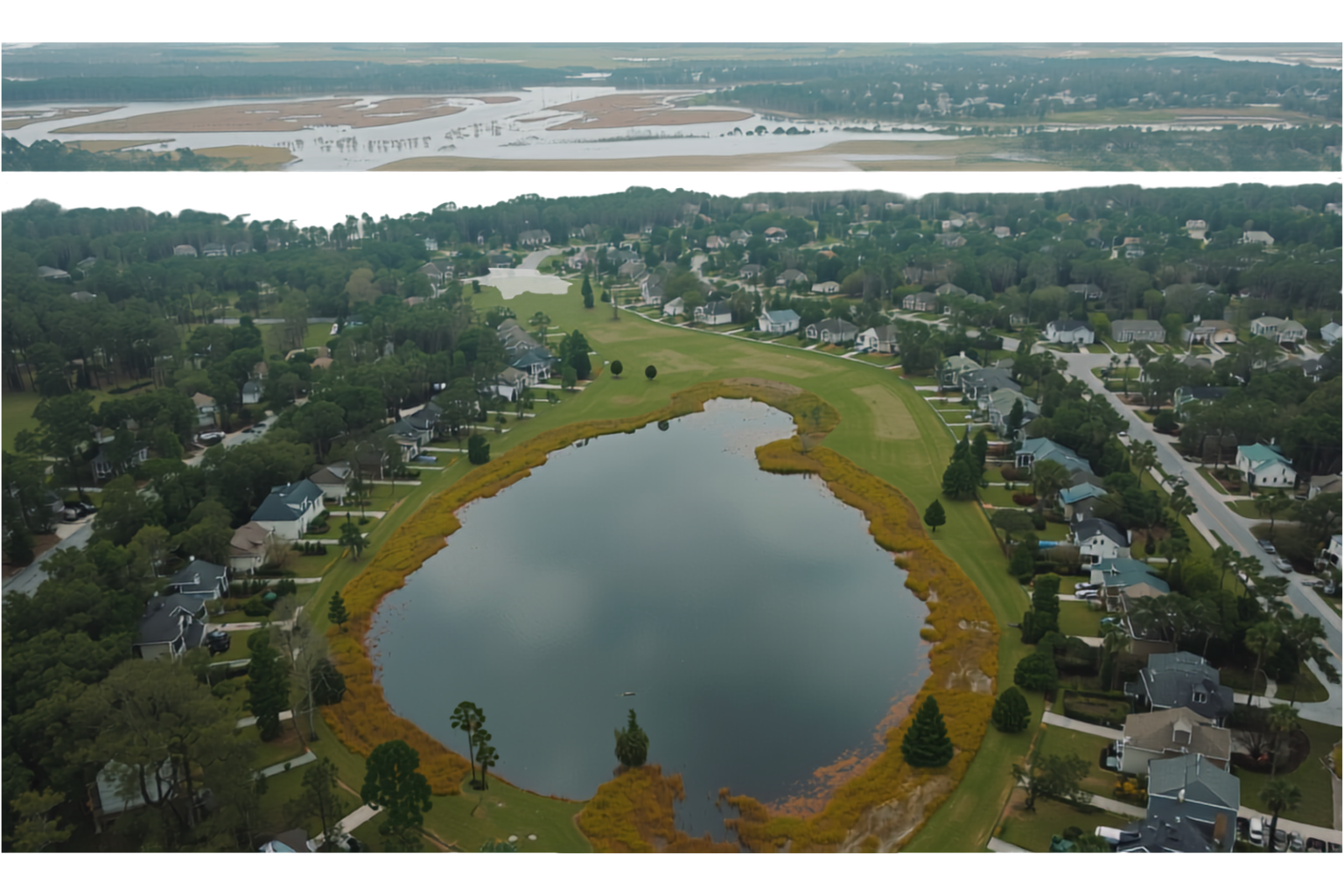
The Church Creek Drainage Basin covers more than 10,000 acres on the west side of the Ashley River and behaves differently than the rest of the city. After two consecutive years of fall flooding, City Council passed a building moratorium there in 2017 and later extended it, having determined that accepted stormwater engineering standards weren't working in that basin. The city has since bought out and demolished some of the most flood-prone homes — the 32 townhomes that became Bridgepointe Ecological Park are the clearest example. Shadowmoss sits inside that basin.
None of that makes the area un-buyable. It makes it a due diligence exercise. Here's the sequence I run before I let a client get emotionally attached:
Pull the FEMA flood zone and the elevation certificate. If the seller doesn't have an EC, that's a $500–$800 order and worth every dollar. An X-zone home two feet above grade and an AE-zone home two feet below behave very differently in an October downpour — and price very differently at renewal.
Check the basin, not just the zone. A property can sit outside a FEMA special flood hazard area and still take water because the surrounding basin has nowhere to drain. Ask the city's stormwater department, and ask the neighbors.
Get an insurance quote before you waive due diligence. Insurance is a purchase decision now, not a closing formality. Wind, hail, and flood premiums on a marginal property can eat $300–$600 a month that never shows up in an online affordability calculator.
Look at the roof, the crawlspace, and the sewer line. Much of West Ashley's charm inventory was built in the 1940s and 1950s. Original cast iron, original wiring, and encapsulation issues are common — and are legitimate repair-credit leverage.
Walk it after a hard rain. Charleston gives you plenty of chances. Nothing in a disclosure packet is as informative as standing in the yard while the street drains.
How to Play It: Buyer and Seller Strategy for Right Now
If you're buying
Sort West Ashley into three tiers and shop them differently.
The proximity tier — Byrnes Downs, Avondale, and the pockets just over the bridge — is no longer cheap and shouldn't be treated as such. Byrnes Downs has carried a median list price near $960,000. You're paying for a five-minute downtown commute, walkable Avondale, and 1940s brick construction on high ground. These trade closer to Mount Pleasant economics and hold value best in a soft market. Buy here for the location and the land, not the finishes.
The value tier — Shadowmoss, the Sam Rittenberg corridor, and the older subdivisions around it — is where the negotiating room lives. Shadowmoss has averaged around $594,500, ranging from roughly $299,000 to $1,000,000. It's also where the flood diligence above is non-negotiable: full contingency package, elevation certificate in hand, bound insurance quote.
The newer-product tier — Carolina Bay and the communities along the outer edges — gives you post-2000 construction, modern stormwater engineering, and amenities at a discount to comparable Mount Pleasant product. If your priority is a house that won't surprise you, start here.
On negotiation: target listings past 45 days and lead with terms, not just price. A seller carrying two payments will often trade a rate buydown, repair credit, or closing-cost contribution faster than a headline price cut. At 6.66%, a seller-funded 2-1 buydown is frequently worth more to your monthly payment than $25,000 off the price — and it's easier for them to say yes to.
If you're selling
The market is rewarding precision and punishing optimism. Price to the last 60 days of closed comps in your specific pocket, not West Ashley's median. Then get ahead of the flood question before a buyer's agent raises it: pull your own elevation certificate, document drainage improvements, and put the insurance history in the disclosure packet. Answering the water question proactively removes the single biggest reason a West Ashley contract falls apart.
The Local Context Most Buyers Miss: What's Actually Being Built Here
West Ashley's price discount exists partly because of a retail and infrastructure gap that is currently being closed with real money.
The Ashley Landing redevelopment between Sam Rittenberg Boulevard and Old Towne Road is a roughly 31-to-35-acre project: about 240,000 square feet of retail, restaurant, and commercial space anchored by Publix, plus residential and nearly an acre of central green space. Woodfield Development closed on its portion in July 2026 and started construction on Westbourne Ashley Landing, a 285-unit mixed-use residential building. Publix is slated to open in its new location by late October 2026, with the first phase of new retail landing late 2026 into early 2027. Total investment runs roughly $48 million public and about $300 million private.
Two things matter here. First, the stormwater improvements attached to the project are due by 2027 — meaningful in a submarket where drainage is the value question. Second, retail anchors of that scale reprice the walkable radius around them. Homes within a mile of Ashley Landing are being valued against what that corner has been, not what it will be in eighteen months. That's the arbitrage.
If you're considering a teardown or substantial renovation on a West Ashley lot, run the numbers before you fall in love. The delta between renovating a 1950s cottage and building new is narrower than most buyers assume once you're into foundation, systems, and code compliance — our Charleston new construction cost breakdown shows where the money actually goes. For investors, the rental math here rhymes with James Island investment property: proximity to downtown employment, durable tenant demand, rents well below Mount Pleasant's.
Frequently Asked Questions About Buying in West Ashley
Is West Ashley a good place to buy a home in 2026?
For buyers who want downtown proximity without downtown or Mount Pleasant pricing, yes. The median sits roughly $290,000 below Mount Pleasant's, inventory has loosened, and Ashley Landing is bringing real infrastructure investment. The caveat: quality varies block to block, largely because of drainage.
Does West Ashley flood?
Parts of it do, and rainfall flooding matters more here than storm surge. The Church Creek Drainage Basin has a history serious enough that the city imposed a building moratorium and bought out some of the worst-affected homes. Other parts sit on high ground and have never taken water. Always pull the FEMA zone, get an elevation certificate, and bind an insurance quote during due diligence.
How much is a house in West Ashley?
Recent data puts the median sale price around $540,000–$560,000, with townhomes starting near $150,000–$300,000 and riverfront homes exceeding $2 million. Neighborhoods vary widely: Shadowmoss has averaged around $594,500, while Byrnes Downs has carried a median list price near $960,000.
Mount Pleasant or West Ashley — which should I buy in?
Mount Pleasant if newer inventory and beach access to Isle of Palms and Sullivan's Island top your list, and your budget supports a median near $830,000. West Ashley if downtown commute time, land, character homes, and price-per-square-foot matter more. Read the Mount Pleasant neighborhood guide alongside this one.
What are the best neighborhoods in West Ashley?
For downtown proximity and character: Byrnes Downs and Avondale. For newer construction and amenities: Carolina Bay. For golf-course living and value: Shadowmoss, with drainage diligence. For long-term appreciation, watch the blocks within a mile of Ashley Landing.
Are West Ashley homes a good investment?
Long-term rentals benefit from a Charleston-wide housing shortage, a short downtown commute, and rents running 20–30% below Mount Pleasant for comparable product. Underwrite conservatively on insurance and stormwater, and verify short-term rental rules with the City of Charleston before assuming any nightly-rental income.
Thinking About Buying, Building, or Investing in Charleston?
Looking to buy, build, or invest in Charleston real estate? I'm Chris Eller, Broker Associate with The Cassina Group and a luxury real estate developer specializing in new construction and coastal properties across Charleston and the barrier islands.
Call/Text: 843-343-3359 | Email: Chris@TheCassinaGroup.com | Website: ChrisEllerRealEstate.com
If you're considering buying, selling, or building in Charleston or anywhere in the Lowcountry, reach out anytime for expert guidance.
