

Downtown Charleston Renovation Permits: The 50% Rule Peninsula Buyers Find Out About Too Late
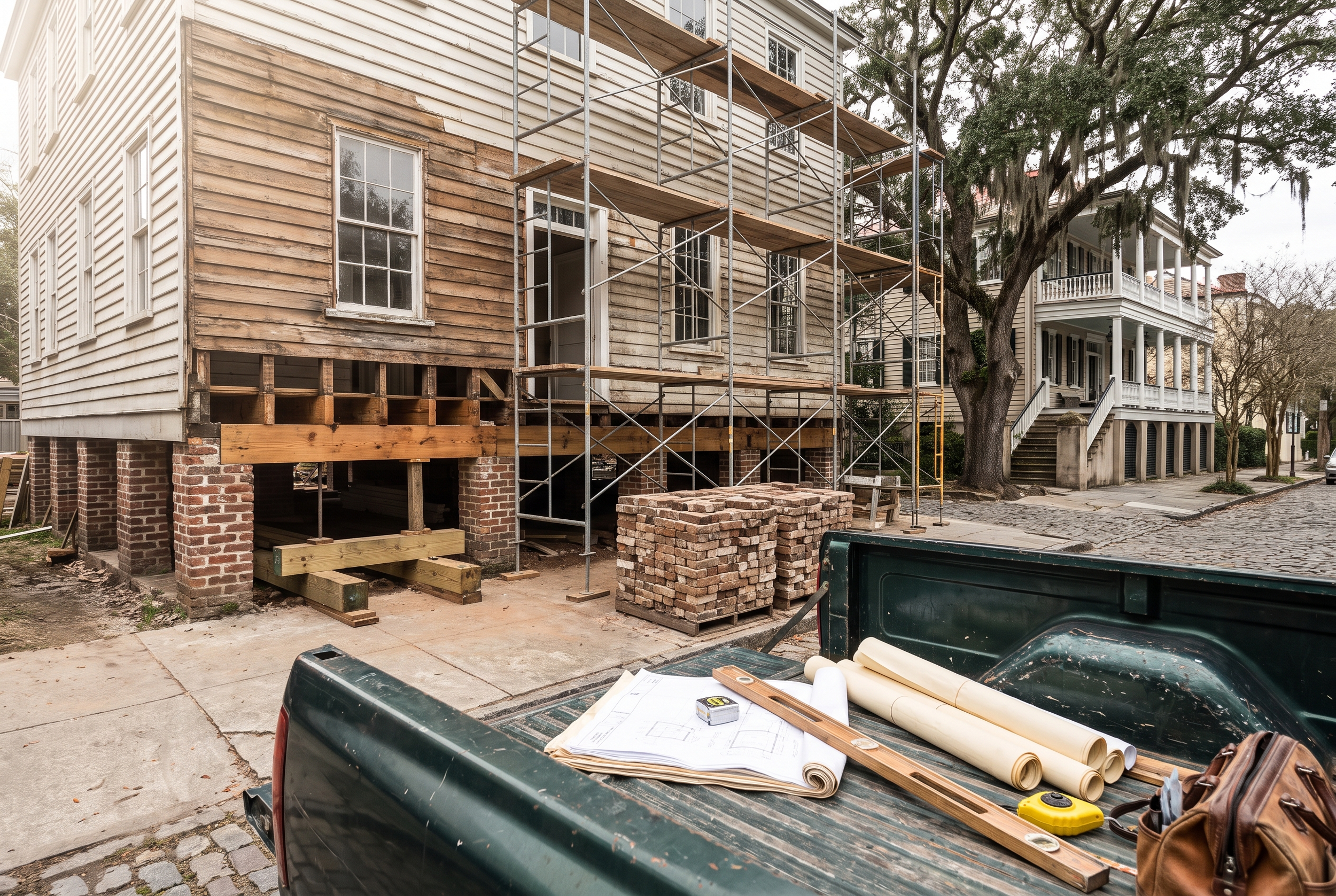
If you are buying a historic home downtown and planning a major renovation, the number that governs your project is not your budget — it is 50% of the structure's assessed value. Under the City of Charleston's substantial improvement rule, once the cost of your work reaches half the building's value, the entire house has to meet current new-construction flood standards. On the peninsula that generally means elevation, and elevation means the Board of Architectural Review. Most buyers learn this after earnest money has gone hard. Below is the test to run before you sign.
Key Takeaways
Charleston's substantial improvement threshold is 50% of the building's assessed or appraised value — not the purchase price, and not including land.
Trip it and the house must meet new-construction flood requirements: 1 foot above base flood elevation for a residential substantial improvement, 2 feet for new construction.
Improvement costs are counted cumulatively over a 12-month period. Phasing a project does not automatically reset the clock.
In the historic district, elevation almost always triggers a Board of Architectural Review hearing. The BAR meets twice a month across conceptual, preliminary, and final stages.
Run the Peninsula 50% Test during due diligence, not after closing. It takes a county record pull, a real scope number, and one call to the floodplain office.
What the Numbers Say Going Into Q4 2026
Financing got more expensive this month. Freddie Mac's Primary Mortgage Market Survey put the 30-year fixed at 6.95% as of September 17, 2026 — up from 6.76% the prior week and 6.26% a year earlier (per Freddie Mac, as of September 2026). That 69-basis-point year-over-year move is the backdrop for every renovation timeline decision on the peninsula, because delay is now carried at a higher rate.
Regionally, the market has loosened slightly. August 2026 Charleston Trident figures show a median sales price of $431,500 (+1.8% year over year), inventory of 5,593 units (+2.1%), 3.6 months of supply, and days on market at 51 — up 6.3% from a year ago (per Charleston Trident Association of Realtors, as of August 2026). Sellers are still getting 95.8% of original list price, but the pace has eased.
The peninsula has not followed the regional softening. Charleston Home's 2026 mid-year analysis put median price inside the Crosstown at $1,400,000, up 7.8%, on transaction volume up 12.1%. Downtown demand is holding. What has changed is that buyers at that price point are increasingly buying to renovate — which is exactly where the permitting math starts to matter.
The Peninsula 50% Test
This is the three-step screen to run on any downtown historic property before due diligence closes. It is a planning framework, not a code determination — the city's floodplain office and your architect make the official call — but it will tell you within an afternoon whether your renovation is a permit or a rebuild.
Step 1 — Find the denominator, not the price
The threshold is measured against the structure's assessed or appraised value. Land is excluded. This is the single most misread element of the rule. On the peninsula, land routinely carries a disproportionate share of total value — a historic address, a deep lot, a harbor view. That means the building number sitting in the county record is often far below what you are paying, and the 50% trigger sits far lower than buyers assume. Pull that figure first. Everything downstream scales off it.
Step 2 — Price the real scope, not the pretty scope
The city counts the cost of reconstructing, rehabilitating, adding to, or otherwise improving the structure — and it counts it cumulatively across a rolling year (per City of Charleston Floodplain Development, as of September 2026). Demolition, structural repair, mechanical, electrical, and plumbing all land in the same bucket as the kitchen. So does the work you were quietly planning to do "next spring." Three phased scopes inside fourteen months do not reset the clock the way most buyers hope they will.
Step 3 — Pick a lane before you go hard
There are only two defensible positions. Either you scope the work to stay clearly under the threshold with real margin for change orders — not 48%, which one structural surprise erases — or you budget the full compliance path from day one: elevation, elevation certificate, a substantial improvement package, and a BAR calendar that moves in two-week increments. The expensive outcome is the middle: a project that starts as a renovation and discovers at month five that it is a rebuild.
Citation & Key Stat
Charleston requires new residential construction to sit 2 feet above base flood elevation and residential substantial improvements 1 foot above BFE — standards in effect since July 1, 2020 (City of Charleston Floodplain Development). Meanwhile the peninsula's mid-2026 median sale price of $1,400,000 runs roughly 3.2 times the $431,500 Charleston Trident regional median for August 2026. But the 50% trigger is measured against the structure's assessed value, not that sale price — so the higher the land share of a downtown address, the lower the renovation number that forces full flood compliance.
Sources: City of Charleston Floodplain Development; Charleston Trident Association of Realtors, August 2026; Charleston Home 2026 Mid-Year Analysis. Calculation by Chris Eller.
What Buyers and Sellers Should Do Right Now
Buyers: extend due diligence long enough to cover three documents — the county assessment showing building value, an elevation certificate, and the property's prior permit history. That last one matters because cumulative improvement is counted against the structure, and a seller's recent $200,000 of work can narrow your runway. Ask for it in writing. If the property sits in a Special Flood Hazard Area, a pre-application conversation with the floodplain office costs nothing and can reprice your entire offer.
Sellers: if the realistic buyer for your peninsula property is a renovator, hand them the flood file up front. An elevation certificate, the assessed building value, and a clean permit history remove the single largest unknown in the transaction. At 51 days on market regionally and rising, the listing that answers the hard question before it is asked is the one that holds its price. Withholding the information does not make it go away; it surfaces during due diligence, with your leverage gone.
What Elevation Actually Costs on the Peninsula
National figures put house lifting at $10–$30 per square foot for raising alone and $20–$80 per square foot for lifting with foundation replacement, or roughly $20,000–$80,000 to raise a home on piers or pilings (per HomeGuide, as of 2026). Downtown Charleston runs at the top of those ranges and usually past them. The reason is not the lift — it is everything the BAR requires around it: masonry pier reconstruction in matching brick, piazza and stair reconnection, historic material sourcing, and drawings from an architect who has been through the process.
Cost or timeline factorWhat it means downtownFreeboard requirement2 ft above BFE new construction; 1 ft above BFE residential substantial improvementBAR reviewConceptual, preliminary, and final stages; board meets twice monthlyPiling or pier elevation$20,000–$80,000 nationally; Charleston historic work typically higherICC assistanceUp to $30,000 toward mitigation for qualifying propertiesFlood risk over a 30-year mortgage26% chance of flooding for property in a Special Flood Hazard Area
The ICC figure and the 26% flood-probability figure both come from the Historic Charleston Foundation's guidance on elevating historic structures, as of 2026. That guidance also flags a constraint peculiar to the peninsula: "sister houses," identical neighboring homes built as a set. The first one elevated in a grouping can end up setting the aesthetic template the rest are measured against — which means your neighbor's timeline may quietly shape your design review.
One piece of good news on schedule: the city has worked down its Technical Review Committee backlog from 67 cases in early 2024 to 5 by 2026, and roughly 80% of permit workload now moves through the online portal. The delay in Charleston permitting is no longer primarily the city's queue — it is completeness and resubmittal cycles on the applicant's side. Submitting a complete package the first time is the cheapest schedule compression available.
Frequently Asked Questions
What is the 50% rule in Charleston?
If the cost of reconstructing, rehabilitating, adding to, or otherwise improving a structure equals or exceeds 50% of the building's assessed or appraised value, the building must meet the same construction requirements as a new building. It also applies to damage from any cause exceeding 50% of building value.
Does the 50% rule use my purchase price?
No. It is measured against the structure's assessed or appraised value, which excludes land. On the peninsula, where land often carries a large share of total value, this threshold is frequently much lower than buyers expect.
Do I have to elevate my historic Charleston home?
Not automatically. FEMA cannot compel an owner to raise a house. But if your project trips the substantial improvement threshold, the structure has to meet the city's current flood design requirements, and elevation is usually how that is achieved.
How long does Board of Architectural Review approval take downtown?
Plan in meeting cycles, not weeks. Projects visible from a public right-of-way in a historic district move through conceptual, preliminary, and final review, and the board meets twice monthly. Elevation projects typically warrant a hearing.
How much does it cost to elevate a house in Charleston?
National ranges run $20,000–$80,000 for pier or piling elevation, with lift-plus-foundation work at $20–$80 per square foot. Historic peninsula projects generally exceed those figures because of BAR-compliant reconstruction and material matching. Get a site-specific number from a contractor who has completed elevations in the historic district.
Looking to buy, build, or invest in Charleston real estate? I'm Chris Eller, Broker Associate with The Cassina Group and a luxury real estate developer specializing in new construction and coastal properties across Charleston and the barrier islands.
Call/Text: 843-343-3359 | Email: Chris@TheCassinaGroup.com | Website: ChrisEllerRealEstate.com
If you're considering buying, selling, or building in Charleston or anywhere in the Lowcountry, reach out anytime for expert guidance.
