

Build on Your Land in Charleston, SC
Whether you already own the lot or you’re still searching, the feasibility review and the land search happen in one conversation. Chris Eller holds both a South Carolina residential builder license and a real estate broker license, a combination that matters most before you own anything. Land searches conducted by a builder-broker catch buildability problems a listing search alone won’t: wetlands buffers, protected trees, or a flood zone that changes the entire foundation budget. Real estate sales and brokerage services are provided through The Cassina Group; Chris Eller is a licensed broker associate there. This page describes the land search and feasibility guidance in connection with a custom home build, and the guidance provided by using Iconic Developments for the entire process could save you thousands based on the experience and knowledge of each local permitting department and City or Town requirements based on the land zoning.
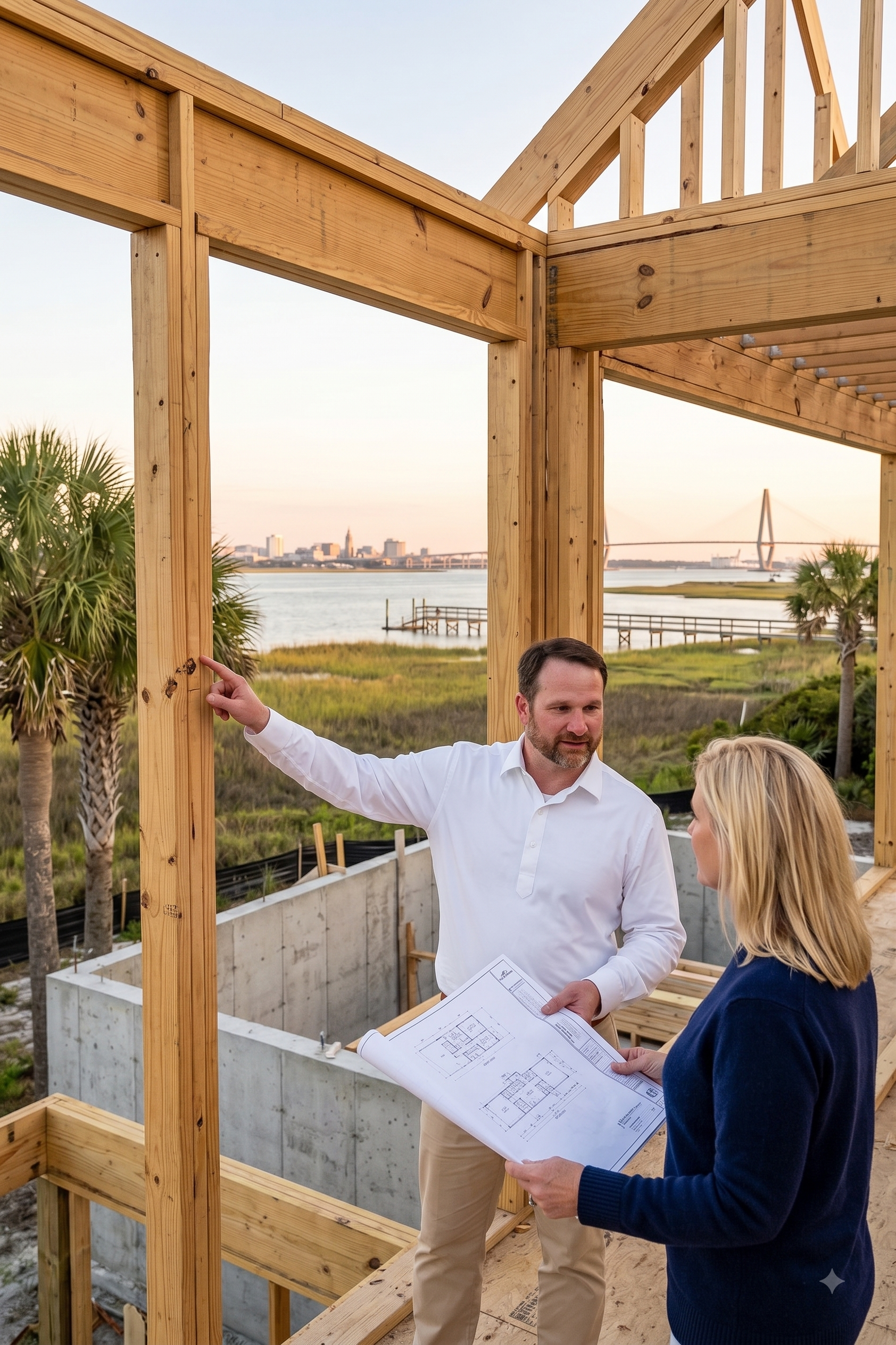
How It Works — Land to Ground-Breaking
| Phase | Typical Timeframe | What Happens |
|---|---|---|
| Discovery & Criteria | One conversation | Budget, target markets (Isle of Palms, Sullivan's Island, Mount Pleasant, Daniel Island, James Island, downtown Charleston), lot size, and non-negotiables established up front — before any lot gets shown. |
| Land Search | Ongoing — days to months | On-market listings plus off-market and teardown candidates surfaced through broker relationships before they hit the MLS. |
| Feasibility Review (per site) | 3–7 days | Flood zone and elevation, zoning and setbacks, grand trees, wetlands and the OCRM critical line, and utility access checked before an offer is written — not after. |
| Offer & Due Diligence | 15–30 days | Survey, title search, geotech if warranted, and final feasibility sign-off inside the contract's due diligence period. |
| Closing | 30–45 days after contract | Financing finalized — land loan or a combined land-and-construction loan — and title transfers. |
| Transition to Design & Build | Immediate | Same builder, same broker, same point of contact moves straight into the design-build process — no new firm, no handoff, no re-explaining the site. |
What Gets Checked on Every Lot
| Item | Why It Matters |
|---|---|
| Flood Zone & Elevation | AE and VE lots require different foundations, not just a different height — and it changes the insurance number, too. |
| Zoning & Setbacks | Sets the buildable envelope before a footprint is drawn. |
| Grand Trees | A protected tree in the wrong place can move a foundation or trigger mitigation. |
| Wetlands & Critical Line | OCRM or Corps jurisdiction can remove usable acreage from an otherwise buildable lot. |
| Utilities (Septic vs. Sewer) | Whether sewer is at the property or merely in the neighborhood changes the site budget materially. |
| Beach & Shoreline Setback | On Isle of Palms and Sullivan's Island lots, OCRM's shoreline setback line can sit well inland of where it looks on a plat. |
Frequently Asked Questions
I found a lot I like — what should I check before making an offer?
Flood zone and required finished floor elevation first, followed by setbacks and any protected trees. Those three items establish the buildable envelope and the foundation type, and together they drive more of the eventual budget than any finish decision made later.
Is it cheaper to buy land and build than to buy an existing home on Isle of Palms or in Charleston?
It depends on the lot and the market you're comparing against, but on Isle of Palms and Sullivan's Island specifically, existing inventory is old enough and land values are high enough that the math frequently favors buying the lot and building new — you're not paying a premium for a 1970s house you're going to gut anyway. In Mount Pleasant, Daniel Island, and James Island the comparison is closer and depends more on the specific lot.
How do I finance buying land and building a house in one project?
Most clients use a construction-to-permanent loan that covers the land purchase and the build in one facility, converting to a standard mortgage at completion. Some buy the land with a shorter-term land loan first and finance construction separately. Which makes sense depends on your timeline and whether you already own the lot outright — worth a specific conversation before you're under contract.
What flood zone is most of Isle of Palms in, and how does that affect the foundation?
Isle of Palms and Sullivan's Island carry a mix of AE and VE flood zones, and the two require genuinely different foundations — VE zones need a foundation designed to break away under wave action, not just an elevated slab. This is checked before an offer goes in, because it changes the foundation budget significantly, not just the finished floor height.
Does the flood zone on my lot require flood insurance, and how much does that typically run?
AE and VE zones require flood insurance if there's a federally backed mortgage on the property, and the premium varies widely based on finished floor elevation relative to base flood elevation — a few feet of freeboard above minimum can meaningfully lower the annual cost. This gets modeled during the feasibility review, not left as a surprise at closing.
What is the grand tree ordinance, and can it stop me from building where I want?
Charleston-area jurisdictions protect certain trees above a trunk-diameter threshold. It won't stop a project outright, but a protected tree in the wrong spot can shift a footprint, add a mitigation fee, or extend the permitting timeline — which is exactly why it's checked at the feasibility stage, before a design is drawn around the wrong assumption.
What's the difference between a teardown lot and vacant land, and which is the better deal?
A teardown is a lot where the existing structure's value has been outpaced by the land underneath it — common on Isle of Palms and Sullivan's Island, where older cottages sit on land worth several times the house. Vacant land skips the demolition cost but is scarcer in the barrier island markets. Which is the better deal comes down to the specific numbers on that lot, not a rule of thumb.
Is the lot on septic or public sewer, and does that change what I can build?
It can. Septic systems require a certain amount of usable, well-draining land for the drain field, which on a tight or wetlands-adjacent lot can constrain the footprint before zoning setbacks even come into play. This is checked alongside the wetlands and utility review, not assumed.
Does OCRM or Corps of Engineers jurisdiction reduce the amount of usable land on a wetlands-adjacent lot?
Yes, and this is one of the most common surprises on Lowcountry land — a lot that reads as a full acre on the plat can have a meaningful share of that acreage inside OCRM's critical line or Corps wetlands jurisdiction and effectively unbuildable. This is checked before the option period runs out, not after.
Do you only work with buyers who are ready to build immediately?
No — some clients are actively searching, others are years out and want to understand what's realistic in a given market before they commit. The feasibility review is the same either way.
Can you help me evaluate a lot I already own?
Yes. The same feasibility review applies whether the land search is still underway or the property has been owned for years and it's time to finally build.
How long does the whole process take, from finding land to breaking ground?
Plan on a few weeks to a few months to find the right lot depending on market conditions and how specific your criteria are, then 45–75 days from a signed contract through closing. From there, the design-build timeline starts.
Which local government actually governs my parcel?
This gets confirmed before anything else, because it changes every answer downstream. A lot on Isle of Palms falls under the City of Isle of Palms; a lot in the historic district or elsewhere in the city limits falls under the City of Charleston; a lot in unincorporated Charleston County — much of Johns Island, for example — falls under county zoning and permitting instead. Each has its own zoning code, building department, and permit portal.
Is my lot affected by the OCRM Critical Line or oceanfront setbacks?
For coastal lots, the South Carolina Department of Environmental Services (SCDES — the successor agency to DHEC, which still runs the OCRM coastal program) sets a Critical Line that defines how close to marsh or ocean you can build. A lot on an actively eroding stretch of beach can also carry a state oceanfront setback on top of that, which together can move the buildable envelope well back from where the property line suggests. This is confirmed with a critical line survey before an offer, not after.
What is my FEMA flood zone, and how high does the house have to be elevated?
Nearly all of Isle of Palms and most of the rest of Charleston sit inside a FEMA Special Flood Hazard Area, so an elevation certificate is part of due diligence on almost every lot in these markets. The zone itself — AE versus the higher-velocity VE — sets the "freeboard" requirement: how far above base flood elevation the lowest habitable floor has to sit, and that number drives both the foundation design and the insurance premium.
What kind of foundation does coastal soil and wind actually require?
A standard slab or crawlspace foundation isn't an option on most beachfront or marsh-adjacent lots. Builders design around driven piles, bored piles, or helical screw piles instead, sized for storm surge, shifting sand, and coastal wind loads — a different engineering conversation, and a different budget line, than a typical inland lot.
What are the setback and lot coverage limits where I'm building?
These run zone by zone, not citywide. On Isle of Palms, the standard single-family districts — SR-1 and SR-3 — cap structures at 40 feet, with roughly 20–30 feet of front and rear setback and 10 feet on the sides depending on lot size and district. Lot coverage limits on impervious surface — roofline, driveway, and patios combined — are checked the same way, before a footprint gets drawn.
Can this lot support a septic system, or is public sewer available?
Large sections of unincorporated Charleston County — Johns Island among them — and parts of the barrier islands still run on septic rather than central sewer. A soil percolation test settles it: if the soil won't absorb water at the required rate, a conventional septic system isn't an option on that lot, which can stall or reshape a project before design even starts.
Do I need Board of Architectural Review or HOA approval before I can build?
If the lot sits in one of the City of Charleston's historic districts, Board of Architectural Review approval on the exterior design is required before a building permit is issued — that review runs in addition to standard permitting, not instead of it. On Isle of Palms, private communities like Wild Dunes layer their own architectural review committee approval on top of the city's process. Both get confirmed before design work starts.
What are the tree preservation rules, and can they affect my site plan?
Charleston-area jurisdictions protect "Grand Trees" — generally live oaks 24 inches or greater in trunk diameter — and removing or severely pruning one without a permit carries real fines and mitigation costs. A tree survey is required before permitting, and a protected tree in the wrong spot can shift a footprint or add a mitigation fee, which is exactly why it's checked at feasibility rather than discovered during framing.
Can I add an accessory dwelling unit or in-law suite?
It depends on the jurisdiction and the zone. The City of Charleston permits ADUs in a number of residential zones, subject to footprint limits, while Isle of Palms applies tighter rules around lot size, dedicated off-street parking, and in some cases owner-occupancy. Worth confirming against the specific parcel before it factors into your program or your numbers.
Can I act as my own general contractor instead of hiring a licensed builder?
South Carolina allows an owner-builder exemption for someone building strictly for their own use, but it comes with real conditions: you personally sign the permit and supervise construction, you must file a disclosure with the county register of deeds — skipping that filing voids the exemption — and you're barred from selling or renting the property for two years after completion. It's a legitimate option in the right situation, and worth understanding fully, including what it doesn't cover, before choosing it over a licensed builder.
What construction hours and noise restrictions apply?
Isle of Palms is a dense residential and tourism community, and its ordinance reflects that — no heavy equipment or outdoor commercial work on Sundays or major holidays, and weekday work generally restricted to daytime hours. Worth factoring into your schedule expectations up front, since it affects how fast even a well-run project can move.
If I build on Isle of Palms, can I operate the home as a short-term rental?
Yes — Isle of Palms allows short-term rentals and currently doesn't cap the number of permits issued. It does enforce real requirements: a business license, occupancy limits tied to bedroom count, and a parking ratio of roughly one vehicle per bedroom or one per 2.5 guests, whichever is greater. If rental income factors into your build budget, these are worth running against the numbers before you finalize the program, not after.
Why work with Iconic Developments instead of separate agents for the land and the build?
Chris Eller holds both a South Carolina residential builder license and a real estate broker license, with more than 22 years in Charleston-area luxury real estate, land development, and custom homebuilding. That means one point of accountability from the first site visit through the final walkthrough — no separate firm to loop in, no handoff between the person who found the lot and the person who builds on it. Call Chris directly to talk through your specific lot or search.
Own a Lot, or Still Looking?
Send the address and any plans you already have. One licensed builder-broker handles the whole conversation — from bare land to move-in — with no handoff in between.
Contact Chris Eller · (843) 343-3359 · Chris@IconicDevelopments.com