

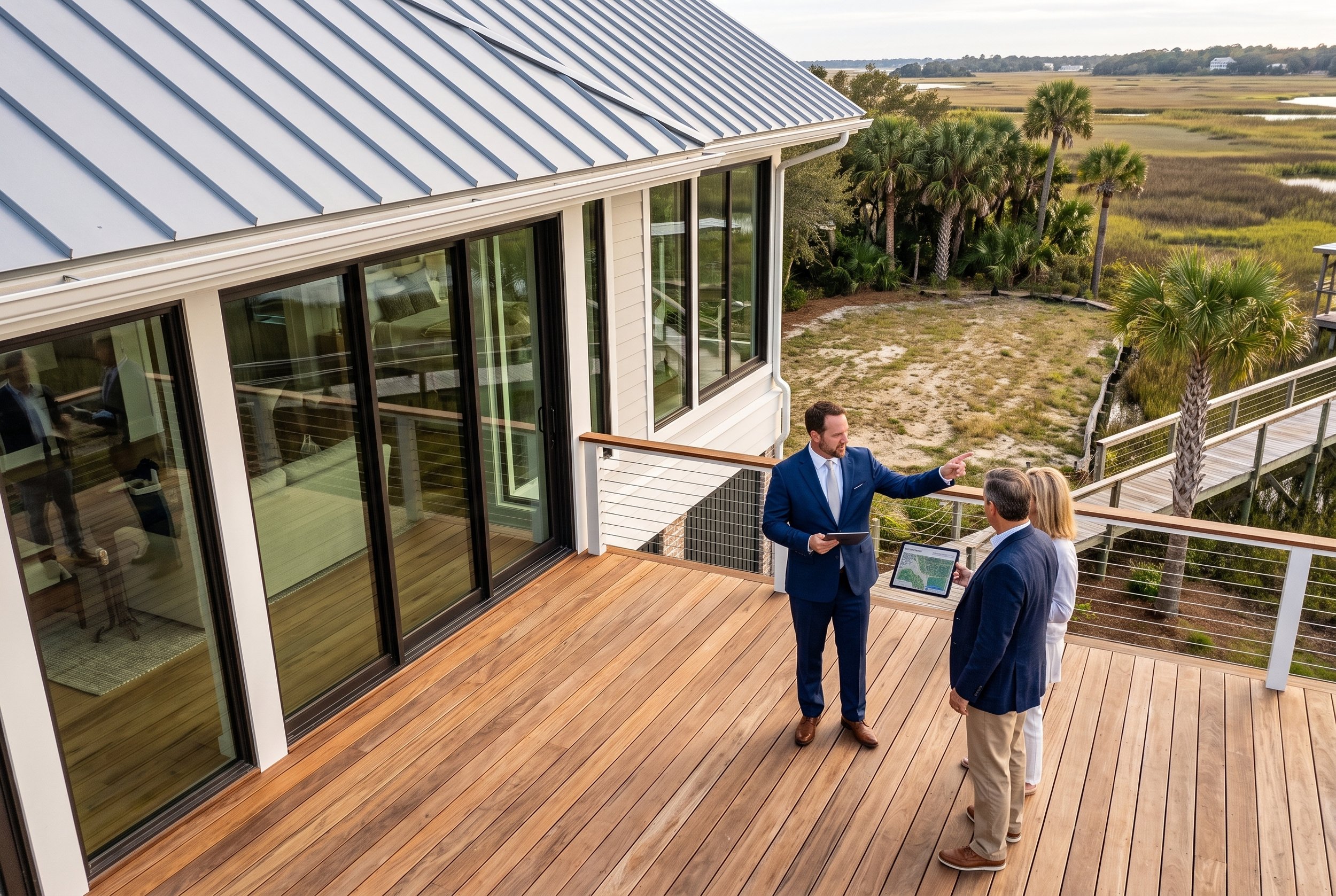
Every few weeks, I get a version of the same call. A buyer has spent a week on Sullivan's Island — maybe rented a friend's place, maybe just had dinner at one of the restaurants on Middle Street — and now they want to own here. Then they open a search portal, see a handful of listings with a median asking price north of $6 million, and ask me the obvious question: is this real, and how does anyone actually buy on this island?
It's a fair question, because Sullivan's Island doesn't behave like any other market in the Lowcountry. There are only about 2,000 residents, no hotels, no short-term rentals, and roughly 1,800 homes on the entire island — and most owners have no intention of selling. In a given year, only a few dozen properties trade hands, and a meaningful share of those never hit the MLS at all. This isn't a market you browse. It's a market you position for.
This spotlight covers what the island actually costs in 2026, why the inventory math will never look like Mount Pleasant's, what the town's famously strict building rules mean if you're planning to renovate or build, and how serious buyers win here — because they do, with the right preparation and the right expectations.
Market Insight: Scarcity Is the Whole Story
Start with the regional backdrop. Across the Charleston metro, the market has loosened meaningfully in 2026 — CTAR data shows inventory above 5,300 homes, roughly 3.4 months of supply, and days on market averaging around 51. The 30-year fixed mortgage rate came in at 6.58% for the week ending July 23 per Freddie Mac, its highest level since last August but still below where it sat a year ago. Buyers across the metro finally have leverage, time, and choices.
Sullivan's Island simply opted out of that story. While Mount Pleasant sellers are adjusting prices and Summerville builders are offering incentives, Sullivan's Island listings in mid-2026 carry a median list price around $6.25 million at roughly $1,600 per square foot, with 2025's year-end median sale price landing near $4.2 million. Homes here take longer to sell — median days on market runs in the 90s — but that's not weakness. It's what happens when nearly every listing is a seven-figure-plus, one-of-one property waiting for a specific buyer rather than a commodity competing on price.
The reason is structural, and it isn't changing. The town prohibits short-term rentals entirely, which filters out the entire investor class that drives volume on Isle of Palms. There's no developable land pipeline — the island is built out, and the accreted land on the front beach is protected. Every buyer is either a primary resident or a true second-home owner, and both groups tend to hold for decades. When supply is fixed and the owner base doesn't churn, prices don't correct the way they do in markets with a construction pipeline. That's the investment thesis in one sentence.
Understanding the Island: A Buyer's Field Guide
Sullivan's Island is small — about 3.3 miles end to end — but the differences from one end to the other matter enormously at these price points.
Front Beach and the Accreted Land
Oceanfront homes on Sullivan's are unusual in one important way: much of the "front beach" sits behind a maritime forest on accreted land, protected land that has grown seaward over decades. Some owners love the privacy and the buffer it provides in a storm; some buyers expect a house directly on white sand and are surprised. Oceanfront and near-ocean estates here routinely trade from $6 million to well past $10 million, and the very best properties have exceeded $16 million. If direct, unobstructed ocean frontage is the requirement, the specific block matters — walk it before you fall in love with the photos.
Middle Street and the Historic Core
The blocks around Middle Street offer the island's signature lifestyle: walk to dinner, walk to the beach, golf cart everywhere. Many homes here are historic — some dating to the island's military era, including converted officers' quarters near Fort Moultrie — and fall under Design Review Board oversight. Charming, irreplaceable, and renovation-restricted: budget accordingly.
The Back Island and Intracoastal Side
Homes along the marsh and Intracoastal side trade at a relative discount to oceanfront — often in the $2.5 to $4 million range for mid-island properties — and offer sunset water views, dock potential on some parcels, and quicker access to the Ben Sawyer Bridge. For buyers who want the island's lifestyle without the front-row premium, this is where I look first.
Buying, Building, and Renovating: What the Rules Really Mean
Sullivan's Island has the most restrictive building environment of any Charleston-area barrier island, and buyers need to understand it before they write a contract — especially if the plan involves renovation or new construction.
First, elevation. New construction must meet the town's Design Flood Elevation — base flood elevation plus the town's freeboard requirement — which in practice means finished floors typically 12 to 15 feet above sea level on elevated pile foundations. That's engineering cost, but it's also insurance math: a properly elevated new home can carry dramatically lower flood premiums than a grandfathered older home sitting low.
Second, size and coverage limits. The town regulates house size relative to lot size through its own zoning formula, along with strict lot coverage and height rules. The 6,000-square-foot program you could build in Mount Pleasant may simply not be permitted on a comparable Sullivan's lot. Any buyer purchasing with expansion plans should have those plans checked against the ordinance during due diligence — not after closing.
Third, process and timeline. Between Design Review Board approval for historic and visible-from-street work, zoning review, and permitting, expect 6 to 12 months before vertical construction on a significant project, and a 12-to-18-month total timeline from lot purchase to move-in on new construction. Build that into your carrying-cost model and your life plans. As someone who builds on these islands, I'll tell you plainly: the process rewards patience and punishes assumptions.
Buyer and Seller Strategy Right Now
For buyers, the current market is quietly favorable. Days on market in the 90s means you can negotiate — on price, on terms, on due diligence periods long enough to properly vet flood zones, elevation certificates, and renovation feasibility. With regional inventory up and the broader luxury market more selective in 2026, sellers who are actually motivated will engage. Three practical moves: get proof of funds or jumbo pre-approval organized before you start (most transactions here are cash or large-jumbo, and at 6.5%+ rates, cash offers carry real negotiating weight); work with a broker who sees off-market activity, because a meaningful share of Sullivan's sales never reach the portals; and underwrite the insurance and elevation picture on every property before you offer, not during escrow panic. More on how luxury buyers are structuring jumbo financing.
For sellers, the discipline is pricing to the property's true peer set, not to last cycle's headlines. Buyers at $4 million and up in 2026 are informed, unhurried, and comparison-shopping against Isle of Palms oceanfront and downtown Charleston trophy properties. Homes that are priced to the market and presented well still command exceptional numbers; homes priced on hope sit for six months and follow the market down. If your home is older and low-elevation, get ahead of the insurance conversation with documentation — a buyer who understands the flood picture on day one is a buyer who doesn't retrade you in week three. Here’s our guide to building on Isle of Palms and Sullivan’s Island.
Local Market Context: Where Sullivan's Fits in the Charleston Luxury Landscape
Within Charleston's luxury market, Sullivan's Island occupies a specific niche: it is the residential-only barrier island. Isle of Palms offers rental income potential and resort amenities; Sullivan's offers the opposite trade — no rental income allowed, and in exchange, a genuine year-round community with a protected, small-town character 15 minutes from downtown Charleston. That trade is exactly what its buyers are paying for.
New construction opportunities are scarce and getting scarcer. With no vacant land pipeline, "new" on Sullivan's almost always means a teardown or taking down to the studs — which puts a premium on lots and on older homes priced for their land value. Replacement cost is substantial: luxury coastal construction on the islands is running roughly $500 to $800+ per square foot before land, elevated foundations, and the soft costs of a long permitting cycle. That replacement-cost floor is one more reason existing island homes hold value: every year, it gets more expensive to recreate what's already standing. See what it costs to build an elevated home on the islands.
For investors, be clear-eyed: with short-term rentals prohibited, Sullivan's Island is not a cash-flow play. It's a scarcity asset — a store of value with a lifestyle dividend, closer to a trophy asset than an income property. Over the past decade, that profile has served owners extremely well, but you should buy it for the right reasons.
Frequently Asked Questions About Sullivan's Island Real Estate
How much does a house on Sullivan's Island cost in 2026?
Recent CTAR data put the 2025 median sale price near $4.2 million, and mid-2026 active listings carry a median asking price around $6.25 million. Realistic entry for a single-family home is roughly $2.5 million on the interior or marsh side, with oceanfront estates running $6 million to $16 million+.
Are short-term rentals allowed on Sullivan's Island?
No. The town prohibits short-term rentals entirely and has no hotels. If rental income is part of your investment model, look at Isle of Palms instead — that's precisely why Sullivan's maintains its quiet, residential character and why its homes command a scarcity premium.
Is Sullivan's Island a good investment?
As an appreciation and scarcity play, it has one of the strongest structural setups in the Southeast: fixed supply, no development pipeline, an affluent owner base with low turnover, and rising replacement costs. As a cash-flow investment, no — rentals under 30 days are banned. Buy it as a primary or second home first, an asset second.
Can you build a new home on Sullivan's Island?
Yes, but almost always on a teardown site, and under the strictest rules of any Charleston barrier island: elevated construction to the town's Design Flood Elevation (finished floors typically 12–15 feet above sea level), town-specific house-size and coverage limits, Design Review Board oversight, and a permitting process that commonly runs 9 –12 months before construction begins.
Sullivan's Island vs. Isle of Palms — which is right for me?
Choose Sullivan's for a year-round residential community, walkable restaurants, no vacation-rental turnover, and maximum long-term scarcity. Choose Isle of Palms for rental income potential, resort amenities like Wild Dunes, more inventory to choose from, and a lower entry price. They're eight miles apart and completely different markets.
How do homes sell on Sullivan's Island if so few are listed?
A meaningful share of transactions happen off-market, through broker relationships and direct owner outreach. If you're serious about buying here, work with a broker who is active on the island and can surface opportunities before they're public — waiting for the portals means seeing only part of the market.
Ready to Make Your Move on Sullivan's Island?
Looking to buy, build, or invest in Charleston real estate? I'm Chris Eller, Broker Associate with The Cassina Group and a luxury real estate developer specializing in new construction and coastal properties across Charleston and the barrier islands. Call/Text: 843-343-3359 | Email: Chris@TheCassinaGroup.com | Website: ChrisEllerRealEstate.com. If you're considering buying, selling, or building in Charleston or anywhere in the Lowcountry, reach out anytime for expert guidance.
