

Isle of Palms and Sullivan's Island New Construction: Why Flood Insurance Now Drives the Design, Not Just the Budget
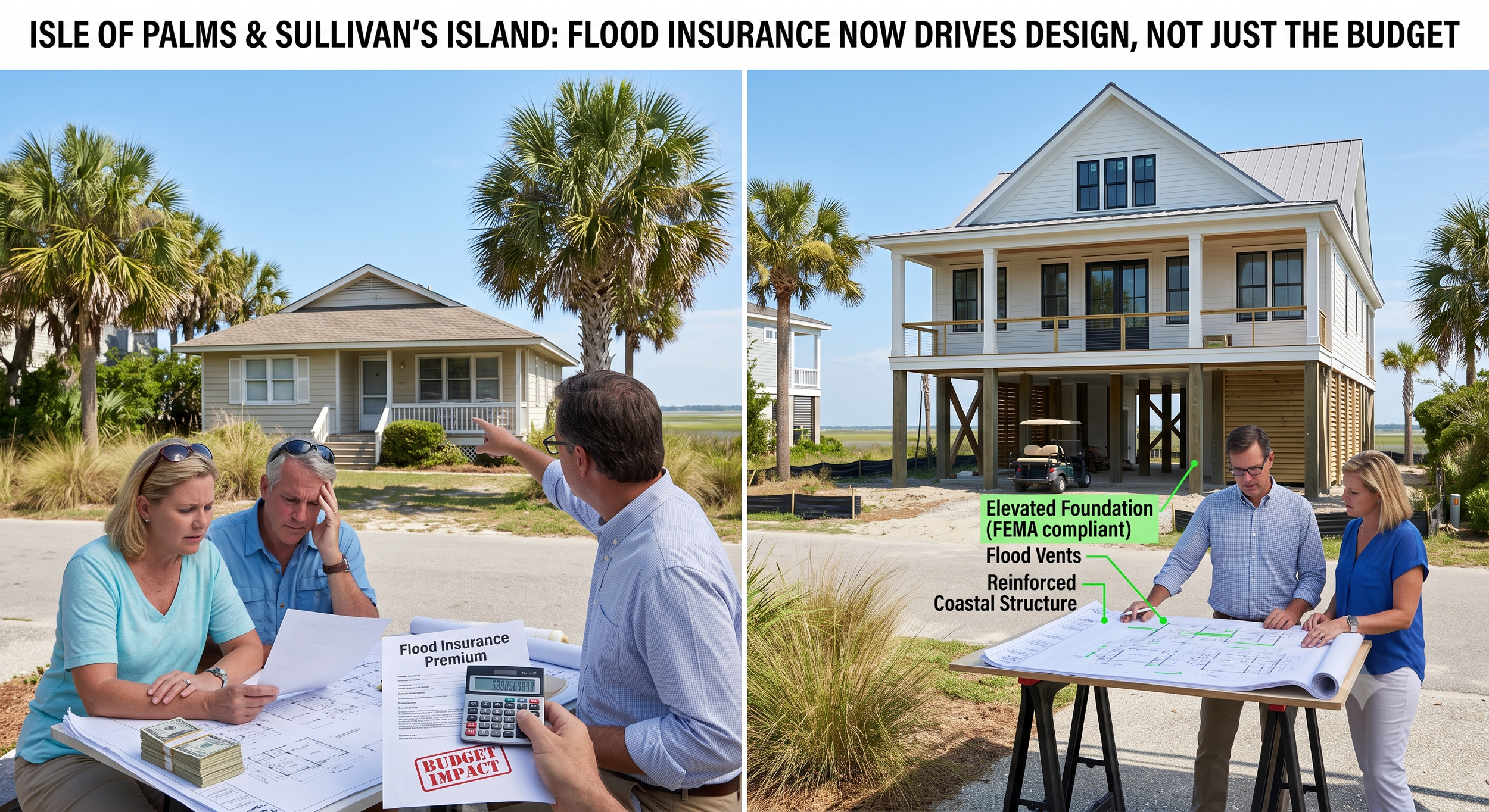
A client called two weeks ago with plans for a five-bedroom new build on Isle of Palms — plans he'd been sitting on for a year. His architect had the layout finished, his contractor had a price, and then his insurance broker ran the numbers on the flood policy, and the whole project went back to the drawing board. Not because of cost overruns in framing or millwork, but because the height of the first floor changed what he'd pay every year for the next thirty. That conversation is happening more often on Isle of Palms and Sullivan's Island right now. FEMA's Risk Rating 2.0 pricing model prices every property individually based on elevation, distance from water, and rebuild cost, and it no longer treats flood insurance as an afterthought handled at closing. For anyone planning new construction or a major renovation on the barrier islands this year, the elevation decision made in the first design meeting is now also an insurance decision — and getting it wrong is expensive in ways that show up on a monthly bill for decades, not just a change order. Here's what's driving that shift, and what buyers, builders, and owners need to know before pouring a footing on IOP or Sullivan's Island in 2026.
What's Changed: Insurance Pricing, Hurricane Risk, and Financing Costs in 2026
Three forces are converging on coastal construction decisions this year. First, NFIP's Risk Rating 2.0 methodology is fully phased in, and it prices flood risk property-by-property rather than by flood zone alone — factoring in elevation, flood frequency, distance to water, and cost to rebuild. On Isle of Palms and Sullivan's Island, that means two homes on the same street can carry very different premiums depending on how many feet of freeboard sit between the finished floor and base flood elevation. Moderate-risk AE zone properties are running $900 to $2,500 a year; high-risk VE zone (coastal high-hazard) properties are running $2,500 to $6,000 or more, and older policies still transitioning to full-risk pricing can climb as much as 18% annually until they catch up.
Second, financing got more expensive alongside insurance. Freddie Mac's Primary Mortgage Market Survey put the 30-year fixed rate at 6.69% the first week of August, the highest reading in more than a year, which means every dollar added to a projected insurance escrow shows up in a buyer's qualifying math too.
Third, NOAA's August update still calls for a below-average Atlantic season — 7 to 13 named storms, 2 to 6 hurricanes — but forecasters are explicit that a quiet season doesn't rule out a direct hit on the Carolina coast. Insurers underwrite for that possibility regardless of the seasonal outlook, which is exactly why the elevation conversation isn't going away even in a calm year.
How Elevation Actually Gets Decided — and Why It's Not Optional
Every new construction project on Isle of Palms or Sullivan's Island starts with the same three numbers: base flood elevation (BFE), design flood elevation (DFE), and freeboard.
Base Flood Elevation and the Design Flood Elevation
FEMA sets the BFE for a given lot based on current flood maps. Isle of Palms then requires the lowest floor of new or substantially improved structures to sit at BFE plus one foot, or 13 feet above mean sea level, whichever is higher — that's the town's design flood elevation. Sullivan's Island applies its own freeboard requirements on top of FEMA's baseline. Neither town treats this as a suggestion; it's checked at permitting and again at the elevation certificate stage before a certificate of occupancy is issued.
VE Zone vs. AE Zone
Flood zone designation changes what the permitting process requires. In VE zones — the coastal high-hazard areas closest to open water, where wave action is a design factor — construction drawings must be stamped by a licensed architect or engineer, and the plans need a V-zone certification confirming the structure can handle wave loads at the required elevation. AE zone projects typically need an engineer's stamp as well, unless specifically exempted. Both zones require flood insurance if there's a federally backed mortgage on the property, and lenders will not close without it.
The Substantial Improvement Trigger
This matters as much for renovation as new construction. If the cost of repairs, additions, or improvements to an existing home reaches 50% of its assessed value within a three-year window, the entire structure must be brought up to current flood standards — meaning a gut renovation on an older Sullivan's Island cottage can trigger the same elevation requirements as ground-up new construction. Owners weighing a major addition should get that 50% threshold calculated before committing to scope, not after.
The Piling Foundation Line Item
Elevating a home to design flood elevation isn't free. Pile-driven foundations using treated timber or concrete pilings run roughly $25,000 to $60,000, depending on the number of pilings, the depth required in the barrier islands' sandy soil, and the finished height above grade. That's on top of coastal South Carolina's general custom home cost of $175 to $350-plus per square foot in 2026 — before land.
What to Do Before You Draw Plans or Make an Offer
For anyone building new: get the elevation certificate conversation started before the architect finalizes floor plans, not after. An elevation certificate is technically optional under Risk Rating 2.0, but if FEMA's default elevation estimate for a lot is wrong, a certificate can meaningfully lower the premium — sometimes enough to justify the survey cost in the first year alone. Ask an insurance broker to run pricing at two or three freeboard heights before locking the foundation plan; an extra foot of pilings during construction is far cheaper than retrofitting after a certificate of occupancy is issued.
For anyone buying an existing home on IOP or Sullivan's Island: request the current elevation certificate and flood policy declarations page during due diligence, not after closing. A seller's existing policy, especially an older one still phasing into full-risk pricing, can be a meaningful factor in the deal if it's clearly documented — buyers should know what they're inheriting before they're locked into a due diligence deadline. If a home has had additions or renovations, ask directly whether any of that work crossed the 50% substantial improvement threshold; if it did and wasn't permitted correctly, that's a liability that follows the new owner.
For anyone renovating: get a written substantial improvement calculation from the town before scoping the project. A kitchen-and-primary-suite renovation that quietly crosses 50% of assessed value turns into a full elevation retrofit, and that's a conversation to have at the planning stage, with the contractor and the building department both at the table, not mid-demolition.
Across all three scenarios, the elevation and insurance numbers now belong in the same spreadsheet as construction cost and purchase price — treating them separately is how budgets get blown.
The Barrier Island Market Isn't Slowing Down for Any of This
Despite higher insurance and construction costs, demand on Isle of Palms and Sullivan's Island hasn't backed off. Isle of Palms' median sale price rose roughly 32.5% year over year to $2.66 million in 2025 per CTAR data, and current listings show an average home value near $1.64 million with a median list price above $2 million — a market still absorbing new elevated construction at a premium. Sullivan's Island, smaller and more tightly held, is running an average home value above $4.2 million with a median list closer to $4.8 million, and inventory stays limited because the island's preservation-minded zoning and construction rules keep new supply constrained by design, not just by lot availability.
That scarcity is exactly why elevation-compliant new construction and thoughtfully renovated coastal cottages continue to command a premium over comparable inland product, even with pilings and insurance added to the cost stack. For investors and second-home buyers, a well-documented elevation certificate and a favorable flood policy are becoming part of the resale pitch, not just a compliance checkbox — buyers shopping the $2 million-plus barrier island tier are sophisticated enough to ask for both. Builders who design for elevation efficiency from day one, rather than bolting it on after permitting pushback, are the ones delivering projects on budget and on schedule in this market.
Frequently Asked Questions
Is flood insurance required for new construction on Isle of Palms or Sullivan's Island?
Yes, if there's a federally backed mortgage on the property and the home sits in a Special Flood Hazard Area, which covers most of both islands. Even without a mortgage, going without coverage on a barrier island is a significant financial risk given rebuild costs.
How much does it cost to elevate a new home to meet flood requirements?
Piling foundations typically run $25,000 to $60,000, depending on the number of pilings, soil depth, and required height above grade, on top of general coastal construction costs of $175 to $350-plus per square foot in 2026.
What's the difference between a VE zone and an AE zone?
VE zones are coastal high-hazard areas where wave action is a design factor and require an engineer- or architect-stamped V-zone certification. AE zones are moderate-risk flood areas that typically also require an engineer's stamp but have less stringent wave-load design requirements.
Does renovating an older home trigger new elevation requirements?
It can. If the cost of the renovation reaches 50% of the home's assessed value within a three-year period, the entire structure must be brought up to current flood elevation standards — a rule worth checking before finalizing renovation scope.
Will flood insurance premiums keep going up?
Under Risk Rating 2.0, policies still transitioning to full-risk pricing can increase up to 18% per year until they reach that number. Getting an accurate elevation certificate is one of the few ways owners can influence that trajectory.
Does a below-average hurricane forecast mean flood insurance requirements are relaxed this year?
No. NOAA's forecasts describe the likelihood of storm activity across the season, not flood zone risk or lending requirements. Elevation and insurance rules are set independently of any single season's forecast and don't change based on it.
Ready to Build, Buy, or Invest on the Barrier Islands?
Looking to buy, build, or invest in Charleston real estate? I'm Chris Eller, Broker Associate with The Cassina Group and a luxury real estate developer specializing in new construction and coastal properties across Charleston and the barrier islands. Call/Text: 843-343-3359 | Email: Chris@TheCassinaGroup.com | Website: ChrisEllerRealEstate.com. If you're considering buying, selling, or building in Charleston or anywhere in the Lowcountry, reach out anytime for expert guidance.
