

Charleston Buyers Are Asking Why Custom Home Prices Aren't Following the National Discount Trend
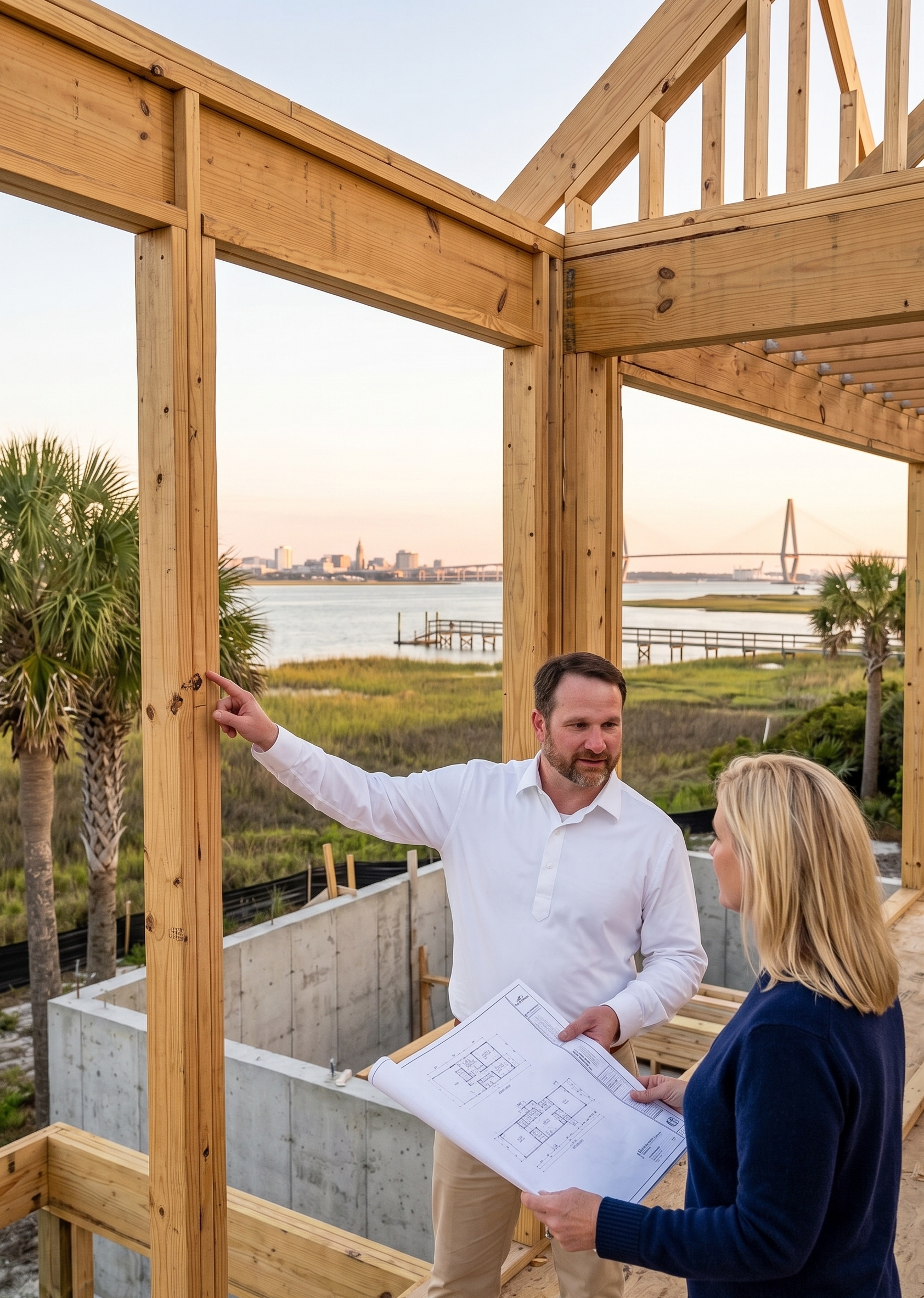
A client called me last week with a screenshot from a national real estate site: builders across the country are cutting new-home prices at a record pace. Her question was reasonable — "So why is my custom build in Mount Pleasant still quoting the same number it did in the spring?"
It's a fair thing to wonder, and I'm hearing it from buyers across Isle of Palms, Daniel Island, and James Island right now. The national headlines about builder incentives and price reductions are real. But they're describing a different product than the one most of my clients are building. Understanding that distinction — and what's actually driving cost in the Lowcountry right now — is the difference between making a smart building decision this fall and waiting on a discount that was never coming to your project in the first place.
Market Insight: Two Very Different Housing Markets Right Now
The story making headlines nationally is a production-builder story. A record 41% of homebuilders are now cutting prices on new homes — the highest share ever recorded — with the average discount running about 6%. Beyond price cuts, 65% of builders are layering in incentives like mortgage rate buydowns to move inventory. The NAHB/Wells Fargo Housing Market Index has fallen to 35, among the weakest readings since the years following the 2008 downturn, as large national builders sit on unsold spec inventory in markets where they overbuilt.
That's not the Charleston custom-build market. Publicly traded builders are discounting production homes they built on spec, in subdivisions, to their own floor plans, to clear balance-sheet inventory. A custom home commissioned by a buyer on a lot in Mount Pleasant or a teardown-rebuild on James Island isn't sitting in anyone's unsold inventory — it doesn't exist until you order it, so there's nothing to discount. Meanwhile, the Charleston Trident Association of Realtors reports the region's median sales price is still climbing, up roughly 7.8% year over year through the first several months of 2026, on the back of steady population growth outpacing new supply.
Mortgage rates add another layer. Freddie Mac's Primary Mortgage Market Survey put the 30-year fixed rate at 6.69% as of early August, essentially flat with a year ago. Rates aren't the tailwind driving national builder discounting — overbuilt spec inventory is. That distinction matters because it tells you the national price cuts are a supply-clearing event, not a sign that construction got cheaper.
Educational Value: What's Actually Driving Your Construction Quote
If national prices are falling but your Charleston quote isn't, the cost drivers are worth breaking down plainly:
Materials are still elevated. NAHB data shows building material costs are up 41.6% since the start of the pandemic, and 2026 tariff actions have added new pressure on top of that baseline. Builders report a typical added cost of roughly $10,900 per home tied to recent tariff actions, with steel and cement each carrying new 25% tariffs and the softwood lumber tariff stack now exceeding 35% on imported product. Some categories have eased — softwood lumber futures and ready-mix concrete have both softened from last year's peaks — but cabinetry, appliances, fixtures, and trim remain among the most tariff-exposed line items on a typical spec sheet, and those are exactly the categories that separate a production home from a custom one.
Skilled labor is genuinely scarce. The construction industry needs an estimated 500,000 additional workers nationally in 2026 to keep pace with current project pipelines, and framers, electricians, and HVAC techs are in especially short supply. Charleston and Greenville have felt this more acutely than most Southeastern metros, because population growth here has outpaced the skilled trades workforce for three straight years. That scarcity shows up in your quote as longer lead times and firmer labor pricing — subcontractors with a full schedule have little incentive to discount.
Coastal-specific costs don't move with the national market at all. Elevation requirements, wind-rated construction for barrier island and flood-zone lots, impact-rated glazing, and OCRM or stormwater permitting timelines are Charleston- and Lowcountry-specific line items that a national builder discounting a slab-on-grade home in Ohio never has to price. On Isle of Palms or Sullivan's Island, these requirements alone can add measurably to a build budget regardless of what's happening with national lumber futures.
Put together, that's why local builders — mine included — are quoting $200 to $300 per square foot for a solid custom build in the Charleston area, with true luxury coastal construction running well past $400 per square foot once elevation, wind-rating, and high-end finish selections are factored in.
Buyer/Seller Strategy: What to Do With This Information Right Now
If you're planning to build in Charleston this fall, here's how I'm advising clients:
Don't wait for a "national discount" that isn't coming to your project. If your plan is a custom home on a lot you already own or are acquiring, the production-builder price war has no mechanism to reach you. Waiting six months in hopes of catching that trend usually just means paying next year's material and labor rates instead of this year's.
Lock your spec sheet early on tariff-exposed categories. Appliances, cabinetry, plumbing fixtures, and windows are where tariff volatility hits hardest. Ordering and pricing those allowances early in the design phase, rather than leaving them as placeholder budget lines, protects your final number from mid-build cost creep.
Use a cost-plus contract with a firm allowance schedule, not a rigid fixed price. In a market where material costs are still moving, a well-structured cost-plus arrangement with clear allowances and a not-to-exceed cap gives you transparency into what you're actually paying for, versus absorbing a builder's margin buffer priced in to protect against volatility.
If you're comparing a production-builder incentive against a custom build, compare total cost of ownership, not sticker price. A discounted production home in an outlying subdivision may carry a lower number today, but a custom home built to your lot, your elevation, and your finish level typically holds value and resale premium in Charleston's supply-constrained core markets far better than a production spec home does.
Local Market Context: Charleston's Custom and Luxury Pipeline
None of this is slowing Charleston's custom and luxury construction pipeline. Demand for waterfront and near-water lots on Isle of Palms, Sullivan's Island, and Daniel Island remains well ahead of available inventory, and I'm seeing sustained interest from both relocating buyers and Charleston-based families moving up into a purpose-built home rather than renovating an older one. CTAR's 2025 year-end report showed single-family home prices up 3.5% for the year even as overall inventory grew — a market absorbing new supply at firm pricing, not one discounting to move it.
For investment-minded buyers, that combination of constrained buildable land, coastal permitting requirements, and steady demand is exactly what supports long-term value in a custom build here, even when material and labor costs sit above where they were two years ago. The homes getting discounted nationally are, by and large, not competing in the same buyer pool as a custom Lowcountry home.
Frequently Asked Questions
Why are national home prices dropping while Charleston construction costs stay high?
National price cuts are concentrated in production-built spec inventory that large builders overbuilt in certain markets. Charleston's growth has kept demand ahead of supply, and custom-built homes here are commissioned rather than built on spec, so there's no unsold inventory to discount.
What is the average cost per square foot to build a custom home in Charleston in 2026?
Most solid custom builds in the Charleston area run $200 to $300 per square foot before land, with true luxury coastal construction — including elevation, wind-rating, and high-end finishes — often exceeding $400 per square foot.
Are tariffs really adding to construction costs right now?
Yes. Current tariff actions on steel, cement, and imported lumber products are adding an estimated $10,900 to the typical build, concentrated in appliances, cabinetry, fixtures, and trim.
Should I wait to build until construction costs come down?
For most custom-build buyers, waiting rarely pays off — labor and material costs have trended upward over time, and Charleston's land and permitting constraints aren't tied to the national production-home cycle.
Is a cost-plus contract better than a fixed-price contract in this market?
A cost-plus contract with a clear allowance schedule and a not-to-exceed cap typically gives buyers more transparency and protection in a market where material pricing is still moving, compared with a fixed price that may build in a larger builder contingency.
Does the labor shortage affect timelines as much as cost?
Yes — with an estimated 500,000 additional skilled trades workers needed nationally in 2026 and Charleston feeling that shortage acutely, buyers should expect firmer subcontractor pricing and longer lead times on framing, electrical, and HVAC scheduling.
Ready to Build in Charleston?
Looking to buy, build, or invest in Charleston real estate? I'm Chris Eller, Broker Associate with The Cassina Group and a luxury real estate developer specializing in new construction and coastal properties across Charleston and the barrier islands. Call/Text: 843-343-3359 | Email: Chris@TheCassinaGroup.com | Website: ChrisEllerRealEstate.com. If you're considering buying, selling, or building in Charleston or anywhere in the Lowcountry, reach out anytime for expert guidance.
