

Not Every Charleston Waterfront Lot Comes With a Dock — Here's How to Know Before You Buy
I get some version of this call almost every month. A buyer has found a beautiful piece of Lowcountry waterfront — Wando River frontage in Mount Pleasant, a tidal creek lot off James Island, marsh views out toward the harbor — and the listing says "dock permit available" or, worse, just "boat access." They're ready to write. And the question they haven't asked yet is the one that decides whether this property is worth what they're about to pay for it: can I actually put a dock here, and when?
Here's the honest answer, and it's the reason I always slow buyers down at this exact moment. In Charleston, water frontage and dock rights are two completely different assets. A lot can front a gorgeous stretch of marsh and still be functionally undockable — because the water is too shallow at mean low tide, because the neighbor's dock corridor eats the buildable alignment, because the property sits inside a subdivision Dock Master Plan that already assigned the slots, or simply because the critical-area permit takes longer than the buyer's timeline allows.
The spread between a dockable waterfront lot and a marsh-view lot in the same neighborhood can run into the hundreds of thousands of dollars. It is, in my opinion, the single most expensive assumption a Charleston waterfront buyer can make. So let's take it apart.
The Waterfront Market Right Now: Steady Money, Slower Process
Let's set the scene with what's actually happening. The 30-year fixed averaged 6.67% as of August 13, 2026, down two basis points from the prior week and roughly nine basis points above where it sat a year ago. That's a rate environment that has stopped moving in any direction that changes behavior — which is precisely why the Charleston market has settled into a slow, selective rhythm rather than a stampede.
Regionally, Charleston Trident numbers show a median around $450,000 overall and roughly $480,000 for single-family, up about 2.3% year over year with closed sales up 2.5%. Healthy, unremarkable, and not the story for waterfront.
Waterfront is its own economy. Entry-level waterfront downtown starts in the $1.5M to $2.5M band. Mid-range waterfront runs $3M to $6M. Estates with a permitted private dock and true deepwater access sit in the $7M to $15M+ range, and the very top of the market goes well beyond that. Those buyers are largely rate-insensitive — we covered that dynamic in Charleston's two-speed luxury market — so the constraint on this segment isn't financing. It's supply of the one thing that can't be manufactured: a lot that will actually support a dock.
How to Tell if a Charleston Lot Is Genuinely Dockable
This is the diligence sequence I walk clients through before they go hard on earnest money. Run it in order, because each step can kill the deal cheaply before you spend money on the next one.
1. Confirm the water depth at mean low tide, not at high tide
"Deepwater" in Charleston means usable depth at mean low tide — you can leave and return on your own schedule. Plenty of tidal creek lots off James Island, Johns Island, and the upper Wando look magnificent at high tide and turn to pluff mud six hours later. If you're planning to keep a 30-foot center console, that's a two-hour-a-day boat. Go see the property at dead low. It is the cheapest inspection you will ever perform.
2. Locate the OCRM critical line and the dock corridor
South Carolina's Bureau of Coastal Management within SCDES regulates any alteration of the critical area, docks included. Your dock has to run within a permissible corridor that respects extended property lines and your neighbors' existing structures. On narrow lots — very common in the Old Village and along established creeks — that corridor may simply not exist. The critical line also drives what you can build upland; if you're evaluating buildable area more broadly, that's a related but separate analysis.
3. Ask whether the property sits under a Dock Master Plan
This one catches out-of-state buyers constantly. In many developing Charleston-area subdivisions, SCDES requires a Dock Master Plan that pre-assigns which lots get docks and where those docks go. If your lot wasn't allocated a slot in that plan, no amount of willingness to pay changes the answer. Ask for the DMP in writing during due diligence, not after.
4. Verify whether an existing permit is transferable
An issued permit on a resale property is a real asset — but only if it's still valid and properly transfers at closing. Get the permit number, the issuance date, the expiration, the stamped drawings, and confirmation of the transfer process. A lapsed permit is worth exactly as much as no permit.
5. Build the real timeline into your contract
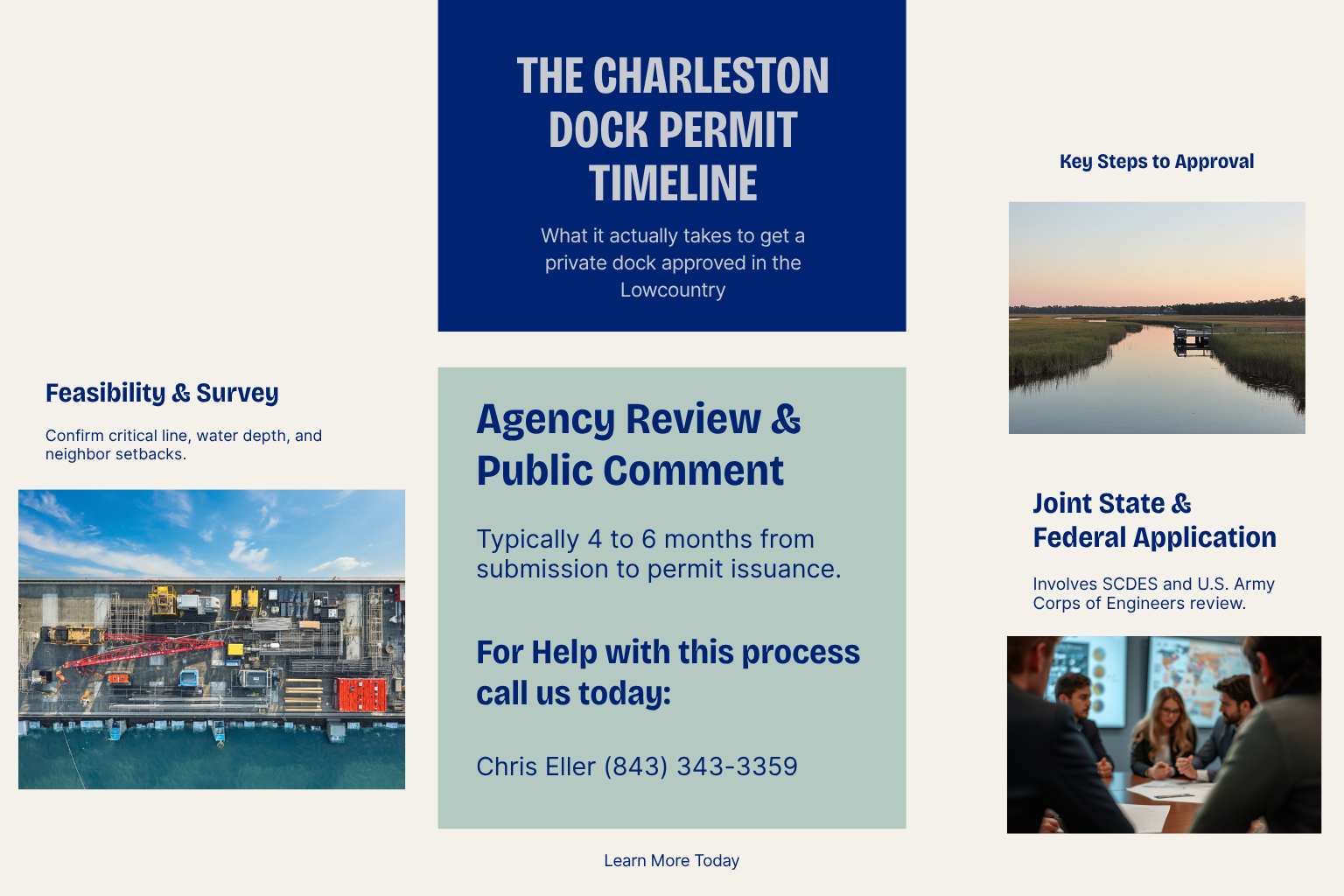
Feasibility work and surveying typically run three to five months. Agency review through SCDES and, where navigable waters are involved, the U.S. Army Corps of Engineers, commonly takes four to six months from a complete submittal. Construction itself is the fast part — four to eight weeks once the barge mobilizes. Plan on a year from "we want a dock" to "we're tying up to it." One timing note worth watching: the South Carolina Dock Regional General Permit (SAC RGP-09) carries an authorization horizon into December 2026, and general-permit renewals are exactly the kind of administrative event that can add weeks to a queue. Start early.
Strategy: How Buyers and Sellers Should Play This Right Now
For buyers, the move is to price dock risk instead of ignoring it. If the dock is permitted and built, you're buying a finished asset and you should expect to pay for it. If the dock is permitted but unbuilt, you're buying a known cost — figure $25 to $45 per square foot installed for a fixed piling dock and $35 to $65 per square foot for a floating dock, plus the walkway, and understand that longer marsh crossings drive that number hard. If the dock is neither permitted nor pre-approved under a DMP, you are buying an option, not an asset, and it should be priced like one. In a market where buyers finally have some room to negotiate, this is the most defensible number you can put on the table.
For sellers, the opposite is true and most Charleston waterfront sellers are leaving money on it. If you hold an issued, transferable permit — or your lot is allocated under a Dock Master Plan — that documentation belongs in the listing package on day one, with the permit number and the stamped drawings attached. It converts a buyer's biggest unknown into a fact, and facts are what support price in a selective market. If you're marketing marsh frontage without dock potential, say so plainly and market the view, the privacy, and the light. Buyers who discover the limitation in week three of due diligence don't renegotiate. They walk.
Where the Dockable Inventory Actually Is
Mount Pleasant remains the deepest market for this, with frontage along the Wando and Cooper Rivers and Charleston Harbor, and the widest range of outcomes — genuine deepwater in some pockets, shallow tidal creek in others a half mile away. Daniel Island's Wando River frontage produces some of the most usable deepwater in the region. James Island and Johns Island offer the most attainable entry into creek-front ownership, with the trade-off being tidal dependence you have to verify property by property.
Downtown Charleston is a category of its own: waterfront supply is effectively fixed, new construction is rare, and the premium reflects scarcity more than mechanics. On the barrier islands, Isle of Palms and Sullivan's Island carry an additional layer — the same coastal permitting realities that already stretch construction timelines there, which we walked through in detail in why your barrier island build timeline runs longer than your contractor told you.
And if you're evaluating raw land rather than an improved property, the marsh buffer and setback rules matter as much as the dock question. Mount Pleasant's wetlands buffer ordinance changed the math on a lot of waterfront parcels, and the same principle applies further out — we looked at that in the context of buying land in Berkeley County.
Frequently Asked Questions
How long does it take to get a dock permit in Charleston?
Plan on roughly a year end to end. Feasibility and surveying typically take three to five months, agency review through SCDES and the Army Corps commonly runs four to six months from a complete submittal, and construction takes four to eight weeks once the barge arrives.
How much does a private dock cost in Charleston?
Current installed pricing runs about $25 to $45 per square foot for a fixed piling dock and $35 to $65 per square foot for a floating dock. Total project cost is driven mostly by how far you have to cross the marsh to reach navigable water, so two lots on the same creek can differ dramatically.
What's the difference between deepwater and marsh front in Charleston?
Deepwater means usable water depth at mean low tide, so you can come and go on your own schedule. Marsh front means you have marsh frontage and the view, but access may be tidal or nonexistent. The price difference between the two is substantial, and the listing language is not always precise.
Can a dock permit be denied?
Yes. Common reasons include insufficient water depth, no permissible dock corridor once neighboring structures and extended property lines are accounted for, environmental constraints in the critical area, or the lot not being allocated a dock under an applicable Dock Master Plan.
Does an existing dock permit transfer when I buy the property?
Usually, but never assume it. Confirm the permit number, issuance and expiration dates, the stamped drawings, and the transfer procedure in writing during your due diligence period.
Should I buy a lot without a dock permit and apply myself?
It can work well if the feasibility supports it — you control the design and often buy at a discount. Just price it as an option rather than a finished amenity, and budget the full twelve-month timeline before you commit.
