

The Isle of Palms Short-Term Rental Math Changed in 2026 — Most Investors Are Still Underwriting on Old Numbers
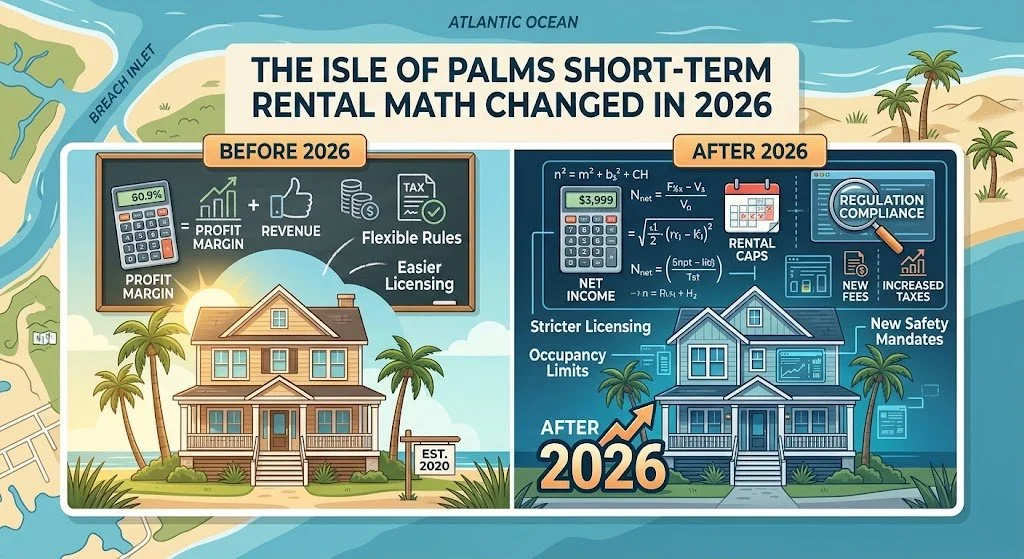
Every week I get some version of the same call: an investor has found a beach house on the Isle of Palms, they have a rental revenue estimate from a listing site or a management company, and they want to know if the numbers work. The revenue number is usually fine. It is everything underneath it that has moved.
Three things changed in 2026, and they changed in the same direction. Financing got more expensive, not less. Coastal insurance repriced hard. And the carrying cost of a non-primary residence in Charleston County is doing more damage to returns than most buyers account for before they are under contract.
None of that makes Isle of Palms a bad asset. It is one of the most supply-constrained barrier island markets on the East Coast, and the town has repeatedly declined to cap rental licenses. But a property that penciled as a cash-flow play three years ago is, at today's cost stack, an appreciation and equity play that happens to generate rental income. Those are two different investments, and buying one while believing you bought the other is how people get hurt.
Here is what the numbers actually look like, and how to underwrite a Lowcountry coastal rental so the surprises happen on the spreadsheet instead of in year two.
What Actually Changed: Rates, Insurance, and Inventory
Start with financing. Freddie Mac's Primary Mortgage Market Survey put the 30-year fixed at 6.76% as of September 10, 2026, up from 6.71% the prior week and up from 6.35% a year ago. That is an eleven-month high, and it arrived in the week leading into a Fed decision — which is worth saying plainly, because a lot of buyers have spent two years waiting for a rate cut that has not shown up in mortgage pricing.
More important for this discussion: that 6.76% is an owner-occupied benchmark. Investor and second-home financing on a coastal short-term rental prices meaningfully above it once you layer in the non-owner-occupied adjustment and the loan size. Underwrite in the low-to-mid 7s, and treat anything better as a win rather than an assumption.
The second change is insurance, and it is the one doing the quiet damage. The South Carolina Wind and Hail Underwriting Association received approval for an 8% increase on dwelling policies effective February 2026. That headline understates what coastal owners experienced — Charleston-area homeowners saw roughly 22% increases heading into 2026 once reinsurance costs, storm losses from Debby and Helene, and carrier repricing worked through. On a barrier island property you are stacking three policies: homeowners, separate wind and hail, and flood. Each one moved.
One trap worth naming: many South Carolina carriers now surcharge or restrict coverage on roofs fifteen years or older, and some will pay only actual cash value rather than replacement cost. On a coastal rental, that turns a single storm into a six-figure decision. Roof age belongs in your due diligence right next to the elevation certificate.
The third change is constructive. Regional inventory is up roughly 14%, days on market in the Charleston metro have stretched to the high 60s, and homes are averaging about one offer. That is not a crash — it is leverage. For the first time in several years, an investor can take the time to do the math before committing, and can negotiate.
How to Underwrite an Isle of Palms Rental: The Full Cost Stack
Most investor pro formas I review fail in the same place. They get revenue roughly right and then understate the carry by 30 to 40%. Build the stack in this order.
Step one: treat the revenue estimate as a range, not a number. Published 2026 data for Isle of Palms spans an enormous spread — annual revenue from roughly $86,600 to $135,000 depending on source and period, with occupancy reported anywhere from 42% to 71%. That variance is not noise to be averaged away. It is the actual distribution of outcomes on the island, driven by beach proximity, bedroom count, pool, and management quality. Underwrite to the bottom of the range and let the upside be upside.
Step two: price debt service honestly. On a $2,000,000 purchase with 25% down, a $1.5M loan at roughly 7.25% runs about $10,200 per month — roughly $123,000 a year before anything else.
Step three: apply the 6% assessment ratio. This is the one that catches out-of-state buyers. South Carolina assesses primary residences at 4% of fair market value. Second homes, investment property, and short-term rentals are assessed at 6%, and they do not receive the owner-occupied school tax credit. On a $2M property, total annual county taxes commonly land in the $20,000 to $28,000 range depending on district millage. Verify the figure with the Charleston County Assessor before you write the offer, not after.
Step four: insurance, at current pricing. Combined homeowners, wind and hail, and flood on a $2M barrier island property realistically runs $18,000 to $35,000 or more annually, driven by elevation, construction type, roof age, and how much wind risk sits with the state association versus the private market. Get a real quote during due diligence — a stale estimate from the seller's renewal two years ago is worthless.
Step five: operations. Full-service management on Isle of Palms generally runs 18% to 25% of gross. Add utilities, landscaping, pest, pool service, turnover, and a genuine reserve for the accelerated wear a high-turnover coastal rental takes. Budget $15,000 to $25,000 beyond management.
Run that stack against a $98,500 mid-range revenue estimate and the gap is obvious: roughly $198,000 to $231,000 of annual carry against under $100,000 of gross revenue. Even a top-performing $135,000 property does not close that. At 50% down, debt service falls to roughly $82,000 a year — better, still short.
One clarification that matters: Isle of Palms' accommodations and sales taxes, totaling around 14%, are collected from the guest rather than paid out of owner revenue. They do not hit your P&L directly. They do affect the guest's all-in nightly price, which affects booking conversion — so they belong in your revenue assumptions, not your expense column.
Buyer and Seller Strategy for Right Now
For buyers, the conclusion is not "don't buy." It is "buy the right way, for the right reason."
Underwrite to appreciation and equity, not to cash flow. Isle of Palms' median sale price rose 32.5% year over year to roughly $2.66 million in 2025 — the largest jump in the region. Barrier island supply is fixed. That is the thesis. If the rental income covers a meaningful share of carry, that is a good outcome, not the premise.
Bring more equity than you think you need. Leverage is the single largest line in the stack, and it is the only one you control at closing.
Use the inventory. With days on market in the high 60s and roughly one offer per home, ask for a real due diligence period, price concessions, and seller credits toward a roof or insurance-driven repairs. That was not available in 2022.
Verify insurance and roof age before removing contingencies. Bind a real quote. Pull the elevation certificate. Confirm the roof's age and the carrier's replacement-cost position on it.
Compare against the mainland. If your objective is actual cash flow rather than barrier island ownership, the math frequently works better inland.
For sellers, the read is different. Rising carrying costs have narrowed the pool of buyers who can absorb a $2M+ coastal property without cash flow, and those buyers are doing more diligence. Two moves matter: get ahead of the insurance question with a current quote and documented roof age ready for buyers, and price to current conditions rather than the 2025 peak. Properties that answer the cost-stack objection before it is raised are the ones still transacting.
How This Compares Across the Charleston Market
The barrier islands are not moving in lockstep with the mainland, and the divergence is instructive. While Isle of Palms posted a 32.5% median price gain, both upper and lower Mount Pleasant softened roughly 7% year over year — upper Mount Pleasant to about $892,500 and lower Mount Pleasant to about $1.2 million.
That gap tells you who is buying what. Isle of Palms and Sullivan's Island are absorbing discretionary, often cash-heavy capital where scarcity matters more than financing costs. Mount Pleasant, Daniel Island, and James Island are more rate-sensitive, because more of those buyers are financing a primary residence — and those are precisely the markets where rising inventory and longer days on market are producing real negotiating room right now.
For new construction, coastal costs compound: elevation requirements, wind and hurricane code, stormwater review, tree mitigation, and flood zone permitting timelines. Those requirements produce a more insurable and more durable asset — new construction to current code typically insures better than an older home with an aging roof — but they belong in the budget at the front end, not discovered at framing. Berkeley County's growth corridors remain where the construction math is friendliest, which is exactly why so much of the region's new supply is going there.
Frequently Asked Questions
Does Isle of Palms limit the number of short-term rental licenses?
No. Isle of Palms voters rejected a proposed cap on short-term rental licenses in November 2023 by a 54% margin, and there is currently no limit on the number of permits issued. Properties still must be licensed through the city, and license requirements and fees are administered by the City of Isle of Palms. Confirm current requirements through the city's rental licensing office before closing.
Can an Isle of Palms short-term rental cash flow in 2026?
At current pricing, financing, and insurance costs, a typical leveraged purchase at 25% down does not cover its carry from rental income. Properties bought with substantially more equity, acquired below market, or operating in the top quartile of revenue can approach breakeven. Treat positive cash flow as the exception rather than the base case.
How much are property taxes on an investment property in Charleston County?
Non-primary residences are assessed at 6% of fair market value rather than the 4% primary-residence ratio, and they do not receive the owner-occupied school tax credit. The practical effect is roughly a 50% higher assessed value plus the loss of the credit. Verify the exact figure for a specific parcel with the Charleston County Assessor's office.
Why is coastal insurance in Charleston increasing so much?
Several pressures at once: reinsurance costs rose sharply in 2026 and carriers pass those through to coastal ZIP codes, storm losses from Debby and Helene reshaped rate filings, and the South Carolina Wind and Hail Underwriting Association received approval for an 8% dwelling increase effective February 2026. Charleston-area owners commonly saw increases near 22% heading into the year.
Is it better to buy on Isle of Palms or in Mount Pleasant right now?
It depends on the objective. Isle of Palms offers fixed barrier island supply and stronger recent appreciation, with a carry cost that requires significant equity. Mount Pleasant has softened roughly 7% year over year and is more rate-sensitive, which means more negotiating leverage and a lower carrying cost per dollar of value. Buyers prioritizing appreciation and scarcity lean island; buyers prioritizing cost efficiency lean mainland.
Let's Talk About Your Charleston Investment
Looking to buy, build, or invest in Charleston real estate? I'm Chris Eller, Broker Associate with The Cassina Group and a luxury real estate developer specializing in new construction and coastal properties across Charleston and the barrier islands.
Call or text: 843-343-3359 | Email: Chris@TheCassinaGroup.com | Website: ChrisEllerRealEstate.com
If you're considering buying, selling, or building in Charleston or anywhere in the Lowcountry, reach out anytime for expert guidance. If you'd like me to run this cost stack against a specific property before you write an offer, send me the address.
