

Buying a Historic Home in Downtown Charleston? Answer These Three Questions Before You Order the Inspection
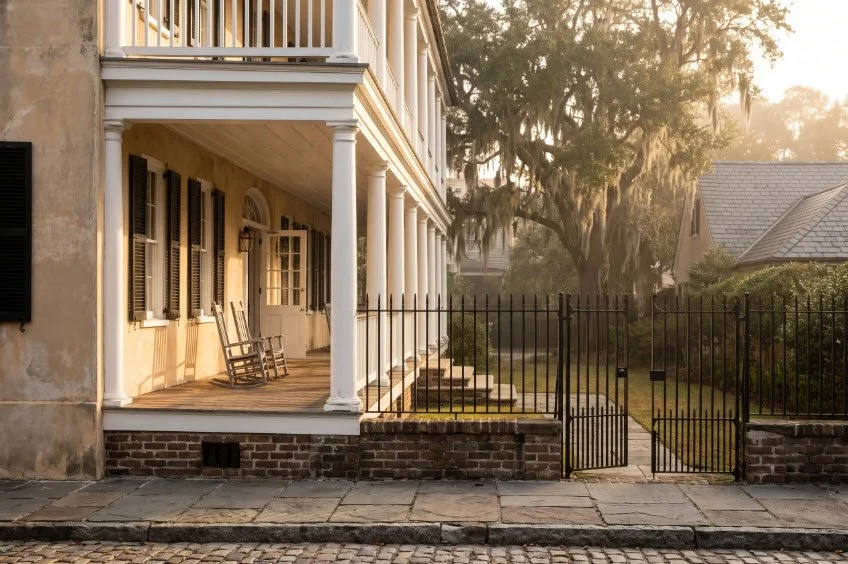
If you're buying a historic home in downtown Charleston, run your due diligence in this order: written rules first, water second, wood last. Most buyers do it backwards — inspection on day one, then the Board of Architectural Review, the flood zone, and the short-term rental category only after they've spent money. We flip it, because the rules governing a peninsula property are the only part of the deal you can't renegotiate or repair. A cracked sill is a number. A permit that doesn't exist is a dead end.
Key Takeaways
Order matters. Written rules → water → wood. Check what money can't fix before you spend money.
Charleston-area homes averaged 51 days on market in August 2026, with 3.6 months of supply and sellers receiving 95.8% of list — roughly $18,900 under asking on a median-priced home (CTAR).
Flood premiums on the lower peninsula range widely, from a few hundred dollars in Zone X to $5,000+ in Zone AE. Get the declarations page before you write the offer.
NFIP policies can often be assumed from the seller, carrying their lower rate forward — one of the most overlooked savings downtown.
30-year fixed sat at 6.76% the week of September 10, 2026 (Freddie Mac PMMS).
What the Charleston Market Is Actually Doing Right Now
Per the Charleston Trident Association of Realtors, August 2026 closed 1,614 regional sales at a median price of $431,500 — up just 1.8% year over year, essentially flat in real terms. More telling: days on market climbed to 51, new listings fell 4.6%, and sellers took home 95.8% of list price. Zillow put the national August median at 27 days to pending. Charleston is running roughly twice that pace.
Meanwhile, the 30-year fixed averaged 6.76% for the week ending September 10, 2026, per Freddie Mac's Primary Mortgage Market Survey — up from 6.71% the prior week and 6.35% a year ago. Rates aren't rescuing anybody. Patience is. You're no longer being rushed through a five-day due diligence window by six competing offers, which means you have room to actually investigate the property. Use it.
The Charleston 3-W Check: Written Rules, Water, Wood
Here's the framework we use on the peninsula — three checks, in this order, because each costs more than the last and only one can be solved with a check at closing.
1. Written Rules — the things money cannot fix
Start here, before you spend a dollar on inspections. On the peninsula you're buying into layered governance: city zoning, the Old and Historic District, Board of Architectural Review jurisdiction, and, in a horizontal property regime, recorded documents that may limit what you can do to your own exterior. Three questions for the first 48 hours:
Does your planned work require BAR approval? Exterior changes in the historic district — windows, roofing, additions, fenestration, some material decisions — run through a review process with its own calendar. Not a reason to walk; a reason to build review time into your renovation schedule and carry cost before you sign.
What short-term rental category, if any, applies to this specific parcel? Charleston administers short-term rentals by property and location, with owner-occupancy and zoning conditions attached. Permits are tied to the property and the operator — do not assume a seller's rental history transfers to you. Verify the category with the City before you underwrite a single night of rental income.
How will this property be assessed? South Carolina applies a 4% assessment ratio to an owner-occupied legal residence and 6% to second homes and investment property. On a peninsula home that difference is real money every year. Confirm the current and projected assessment with the Charleston County Assessor, and run the tax consequences past your CPA — not your agent.
2. Water — the thing you price, not fix
Much of the lower peninsula sits in high-risk AE flood zones, with pockets of Zone X on higher ground. Zone X isn't immunity — it's a current map designation, and maps get revised.
Since 2021, the NFIP has priced flood risk property by property under Risk Rating 2.0: distance to water, flood type, foundation, and lowest-floor height relative to expected flood levels. Two homes on the same block can carry very different premiums. Published peninsula ranges run roughly $400–$800 in Zone X, $800–$1,500 in transitional areas, and $1,500 to more than $5,000 in Zone AE.
So: request the seller's declarations page early; ask whether the NFIP policy is assumable, since inheriting their rate and its annual increase cap can save thousands versus a fresh full-risk policy; and get the elevation certificate if one exists. On a home raised on piers, that certificate is often worth more to your payment than any repair credit you'll negotiate later.
In August 2026 the average Charleston-area seller closed roughly $18,900 below asking on a median-priced home — and homes took 51 days to sell, nearly twice the 27-day national pace. That gap is the downtown buyer's due diligence budget.
Calculated from CTAR's August 2026 figures ($431,500 median sale price at 95.8% of list received; 51 days on market) and Zillow Research's August 2026 national median of 27 days to pending. Attribution: Chris Eller, The Cassina Group.
3. Wood — almost always just a number
Now order the inspection. On a 150-year-old peninsula home your inspector is looking at moisture and movement: sill and joist condition at the crawl space, wood-destroying organism history, foundation settlement, drainage. Bring a structural engineer if movement is flagged, and a builder who has actually restored historic Charleston framing — not a general contractor guessing at heart pine.
Wood goes last because nearly every finding here converts to a dollar figure — and in a 51-day market, dollar figures are negotiable in your favor.
The True Monthly Carry worksheet
Before you commit, build the full number. Peninsula buyers routinely underwrite principal and interest, then get surprised by everything below it.
Line itemWhere the number comes fromPrincipal & interestYour lender's quote at the current 30-year fixed (6.76% as of September 10, 2026)Flood insuranceSeller's declarations page — confirm whether the policy is assumableWind & hail coverageSeparate from homeowners on the coast; quote it separatelyHomeowners / dwellingReplacement cost on historic materials, not square-foot averagesProperty taxes4% vs. 6% assessment ratio — confirm with the County AssessorHPR or regime duesRecorded documents, plus reserve study if one existsDeferred maintenance reserveInspection findings amortized over your hold period
Add those seven lines — that's your real monthly number. If it works, you're buying with clear eyes. If it doesn't, you found out for the price of an inspection instead of a closing.
How to Use Your Leverage Right Now
A 3.6-month supply isn't a buyer's market in the classic sense, but it is a negotiable one. Three moves that work in this specific market:
Buy the days, not just the discount. Ask for a due diligence period long enough to cover BAR questions, insurance quotes, and a specialist inspection. On a property sitting past 51 days, most sellers will trade time before they trade price — and downtown, time is what protects you.
Price the insurance before you price the offer. Get real flood and wind quotes during due diligence, not after appraisal. A $4,000 annual premium swing moves your effective purchase price by tens of thousands over a hold period, and it's a defensible basis for an adjustment.
Ask what the seller already knows. Elevation certificates, BAR approvals, closed permits, termite bonds, regime minutes. A decade-long owner usually has a file, and it beats another week in public records.
Downtown Charleston in Context
The peninsula doesn't trade like the rest of the region, and a $431,500 regional median tells you little about South of Broad, Harleston Village, or Cannonborough-Elliotborough. What the regional data gives you is direction: fewer new listings, longer marketing times, buyers willing to wait. In a historic market where supply is genuinely finite, that rewards the prepared buyer over the fast one.
It also changes the renovation math. When we underwrite a downtown restoration, review timelines, specialty trades, and coastal material costs carry as much weight as purchase price. A full envelope restoration and a cosmetic refresh can list within $100,000 of each other and land $500,000 apart on true cost. That gap is where money is made or lost downtown — and it's why the 3-W Check runs rules first.
Frequently Asked Questions
How long should a due diligence period be on a downtown Charleston home?
Longer than the suburban standard. Allow time for a specialist inspection, flood and wind quotes, short-term rental verification if that matters to you, and answers on any BAR-reviewable work. In a 51-day market, that request is usually granted.
Do I need BAR approval to renovate a historic Charleston home?
Exterior work within the Old and Historic District generally requires review by the Board of Architectural Review. Interior work typically does not, though permits still apply. Confirm jurisdiction for your specific parcel with the City of Charleston before you finalize a renovation budget or schedule.
Is flood insurance required in downtown Charleston?
Lenders require it in high-risk zones such as AE. In Zone X it may be optional but is often still worth carrying, since maps get revised. Under Risk Rating 2.0 pricing is property-specific, so quote the actual address rather than a zone average.
Can I short-term rent a home I buy on the Charleston peninsula?
Only if the specific parcel qualifies under the City's short-term rental categories, which carry location, zoning, and owner-occupancy conditions. Permits do not automatically follow a sale — verify with the City before underwriting rental income.
Are Charleston home prices falling in 2026?
Regionally, no — the August 2026 median rose 1.8% year over year per CTAR. What changed is pace and negotiability: homes take longer to sell, and sellers are receiving 95.8% of list rather than bids above it.
What's the single most common mistake downtown buyers make?
Ordering the inspection first. It tells you what the house needs — not whether the city will let you do it, or what it costs to insure. Run the rules and the water first.
Let's Talk About Your Charleston Purchase
Looking to buy, build, or invest in Charleston real estate? I'm Chris Eller, Broker Associate with The Cassina Group and a luxury real estate developer specializing in new construction and coastal properties across Charleston and the barrier islands.
Call or Text: 843-343-3359 | Email: Chris@TheCassinaGroup.com | Website: ChrisEllerRealEstate.com
If you're considering buying, selling, or building in Charleston or anywhere in the Lowcountry, reach out anytime for expert guidance.
Sources: Charleston Trident Association of Realtors, Local Market Update, August 2026 · Freddie Mac Primary Mortgage Market Survey, September 10, 2026 · Zillow Research, August 2026 Market Report
