

On Sullivan's Island, Your Construction Budget Is Decided Before the Framing Starts
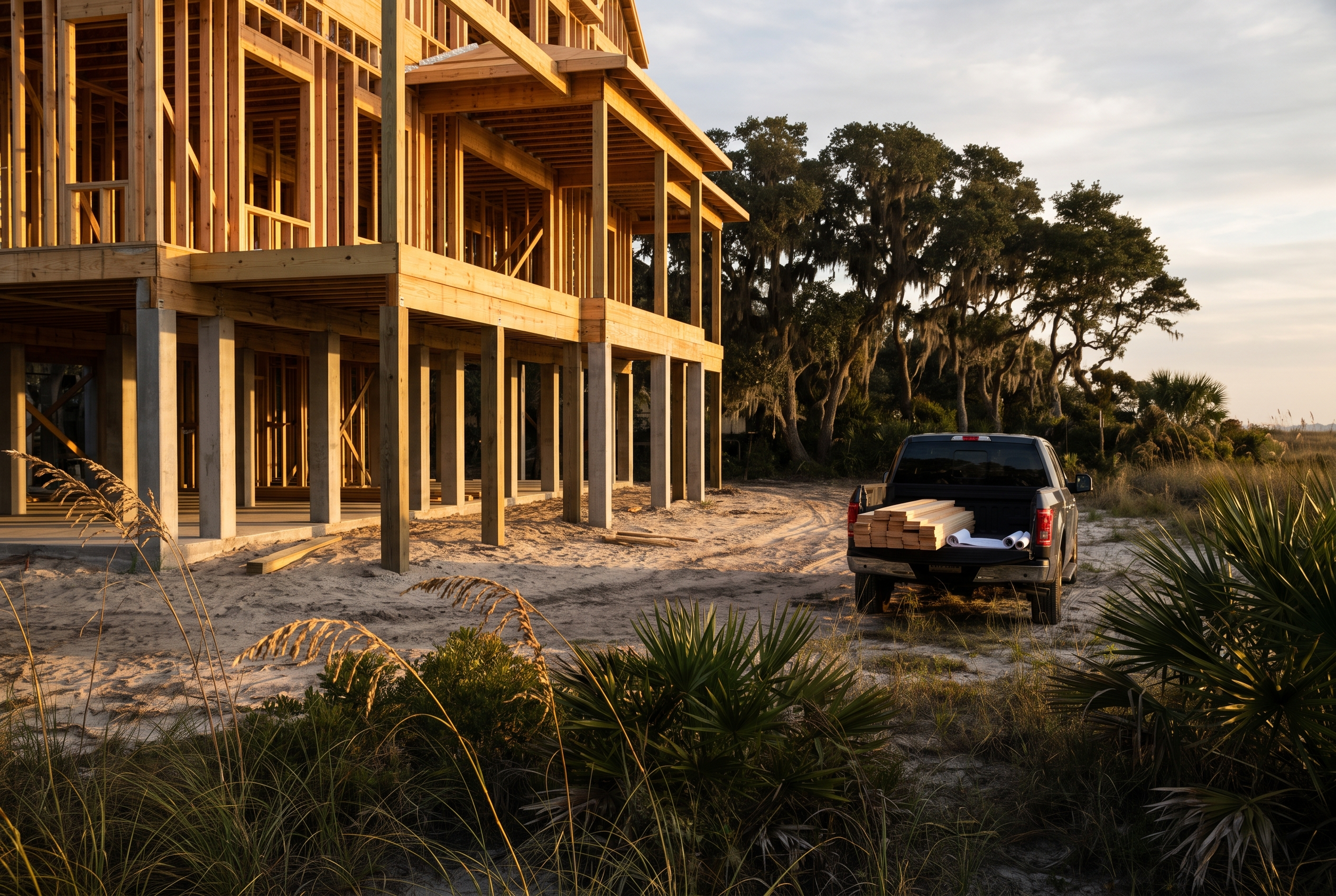
If you are asking what it costs to build on Sullivan's Island in 2026, the honest answer is that the per-square-foot number is the least useful figure in the conversation. On this island, the budget is set by three things that are all locked in before a single wall goes up: what the lot demands in elevation and site work, how long the design review calendar runs, and which size of builder is buying your materials. Get those three right and the finish level becomes a choice. Get them wrong and the finish level becomes whatever is left.
Key Takeaways
The lot, not the house, sets the budget. Elevation, pilings, access and stormwater are priced before any finish decision matters.
Regulatory cost now runs $131,734 per new single-family home nationally — 26.4% of the average sales price, per NAHB, June 2026.
Material costs rose a median 6.7% over twelve months, but 9.1% for builders starting five or fewer homes a year — the exact profile of most Sullivan's Island custom builders (NAHB, August 2026).
Borrowing got more expensive this month: the 30-year fixed averaged 6.95% on September 17, 2026, up from 6.76% the prior week (Freddie Mac).
The regional market is slower, not weaker — 51 days on market and 3.6 months of supply in August 2026 (CTAR).
Budget the review calendar as a carry cost, not as a formality.
What the Market Is Actually Doing Right Now
Three forces are pressing on Lowcountry build budgets at once, and they are not moving in the same direction.
Financing got more expensive in the last two weeks. The 30-year fixed-rate mortgage averaged 6.95% for the week of September 17, 2026, up from 6.76% the week before and 6.26% a year ago, per Freddie Mac's Primary Mortgage Market Survey. Construction-to-permanent lending prices off the same curve, which means every month the review process runs is a month of interest reserve you are spending.
Materials are still climbing. Builders reported a median 6.7% increase in material costs over the prior twelve months, per the NAHB/Wells Fargo Housing Market Index published August 2026. Regulatory cost has moved further and faster: $131,734 per new single-family home, or 26.4% of the average sales price, up more than 40% in about five years, per NAHB, June 2026.
Meanwhile the resale market has loosened its grip. Charleston Trident posted a median sales price of $431,500 in August 2026, up 1.8% year over year, with days on market at 51 (up 6.3%) and 3.6 months of supply, per the CTAR market report, August 2026. Costs are rising into a market that is no longer absorbing them instantly. That gap is where build budgets get exposed.
The Sullivan's Island Cost Stack: A Three-Step Framework
Most build budgets fail because they are assembled in the wrong order — finishes first, site work last. The Cost Stack reverses it. Price from the ground up, in this sequence.
Step 1 — Price the Dirt Before the Drywall
On a barrier island, the foundation is not a line item, it is a structural system. Required finished-floor elevation drives pile depth and count, which drives stair runs, utility routing, driveway grading and the height of everything above. Two lots three blocks apart can differ by six figures in site cost with an identical floor plan. Before you price a house, price the dirt: survey, elevation certificate, geotechnical report, tree inventory, stormwater approach and utility connections. If a builder gives you a per-square-foot number before seeing those, the number is a guess.
Step 2 — Underwrite the Review Calendar, Not the Build Calendar
Sullivan's Island reviews development through its Planning & Zoning department, with design review layered on top of standard permitting; the town's current ordinance, zoning map and recent amendments are published through its Planning & Zoning department. What matters financially is that the review calendar runs on meeting cycles, not on your schedule. A resubmittal does not cost you two weeks of drawing time — it costs you a full cycle, and at 6.95% money, carry on a $2M project is real. Build the expected number of cycles into the schedule and the interest reserve before you sign, and put design fees on a timeline that assumes at least one round of revisions.
Step 3 — Set Contingency Against the Small-Builder Number
Here is the piece almost every budget gets wrong. NAHB's data shows material inflation is not one number — it runs 9.1% for builders starting five or fewer homes a year versus 1.8% for builders with 100 or more starts. The custom builder you want on a Sullivan's Island project is, by definition, a low-volume builder. They do not have national purchasing agreements. So a contingency set against the national median understates your actual exposure by a wide margin. Set contingency against the low-volume figure, and lock long-lead items — windows, standing-seam roofing, impact glazing, elevator equipment — at contract rather than at rough-in.
Citation & Key StatRegulatory cost alone now adds $131,734 to a new single-family home — roughly 31% of the $431,500 median price of an entire existing home in the Charleston region. On the barrier islands, the compliance layer costs about what a whole house costs twenty minutes inland.
Calculated from NAHB regulatory cost study (June 2026) and CTAR median sales price, August 2026.
Buyer and Seller Strategy for the Next 90 Days
If you are buying a lot to build: make your diligence period long enough to complete survey, elevation and tree work before you go hard on earnest money. Price the site work first and let it set your ceiling on lot price — not the other way around. On a cost-plus contract, negotiate the fee structure and the allowance schedule at the same table; allowances set six months ago against last year's material curve are where overruns hide. And confirm insurability early with a coastal agent, because wind and flood pricing shapes the carrying cost of the finished asset.
If you are selling a teardown or a buildable lot: understand that a developer is paying you finished value minus the full cost stack minus profit. The faster you can shrink a buyer's unknowns, the more they can pay. A current survey, an elevation certificate, a tree inventory and any prior review correspondence are cheap documents that remove risk premium from your price. In a market running 51 days on market, the lot with answers attached trades first.
How Sullivan's Island Compares Across the Lowcountry
The cost stack applies everywhere on the coast, but the weighting shifts by market.
MarketDominant budget driverWhat to watchSullivan's IslandSite elevation and design review cyclesVery limited lot supply; review calendar drives carry costIsle of PalmsElevation, wind exposure, insuranceFront-row wind requirements; oceanfront site accessMount PleasantLand price and tree protectionInfill lots with mature canopy; mitigation costsDowntown CharlestonHistoric review and structural repairRenovation thresholds; unknowns behind existing wallsDaniel Island / Berkeley growthLand development and infrastructureLarger parcels; stormwater and entitlement timelines
Sullivan's Island sits at the top of the difficulty curve and the top of the value curve for the same reason: supply is finite and the barrier to building is high. That barrier is what protects the value of what gets built. Buyers who underwrite it as a cost rather than resent it as an obstacle tend to do well here.
Frequently Asked Questions
How much does it cost to build a house on Sullivan's Island?
There is no reliable single per-square-foot figure, because site work and elevation vary so widely lot to lot. The useful approach is to price the lot's site requirements first, then layer the house on top. Any builder quoting a firm number before a survey and elevation certificate is estimating, not pricing.
Why is coastal construction more expensive than inland building?
Elevated pile foundations, wind-rated assemblies, impact-rated openings, corrosion-resistant fasteners and longer site access all add cost that inland projects never incur. The structural system starts below grade and continues through the roof.
How long does the approval process take?
It runs on meeting cycles rather than calendar days, and one resubmittal can cost a full cycle. Confirm current timelines directly with the Town of Sullivan's Island Planning & Zoning department at Town Hall before you set a schedule.
Should I build now or wait for rates to fall?
Rates moved up this month, to 6.95% on September 17, 2026, and no one can forecast the next move. What is more predictable is that material and regulatory costs have risen every year of the last five. Waiting trades a possible financing saving against a probable construction cost increase. Talk to your lender about how a construction-to-permanent structure handles that risk in your situation.
Is a teardown lot a better buy than an existing home here?
It depends entirely on whether the existing structure has value you can use. Run both paths through the same cost stack — land plus site work plus build plus carry — and compare each against realistic finished value. Renovation is often the more complicated of the two, not the simpler one.
What contingency should I carry?
Set it against low-volume builder cost inflation rather than the national median, and hold it separately from your allowance budget so that a single long-lead item does not consume it.
Looking to buy, build, or invest in Charleston real estate? I'm Chris Eller, Broker Associate with The Cassina Group and a luxury real estate developer specializing in new construction and coastal properties across Charleston and the barrier islands.
Call/Text: 843-343-3359 | Email: Chris@TheCassinaGroup.com | Website: ChrisEllerRealEstate.com
If you're considering buying, selling, or building in Charleston or anywhere in the Lowcountry, reach out anytime for expert guidance.
