

Berkeley County Is Where Charleston Buyers Are Actually Closing Right Now
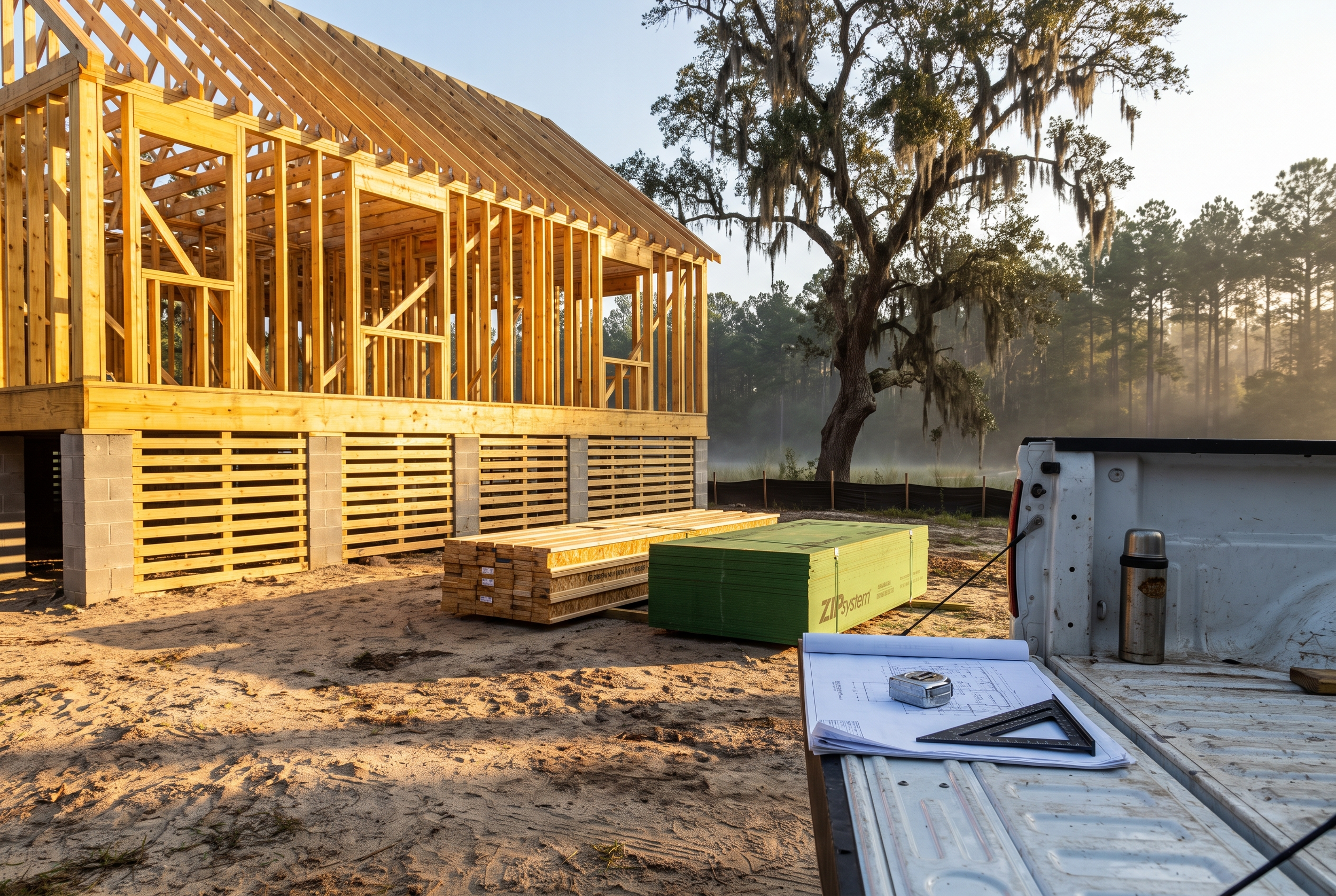
If you have been shopping Charleston this fall and the math keeps coming up short, look at Berkeley County first. The median single-family home there closed at $430,000 in September 2026, against $715,000 in Charleston County — a $285,000 spread on the same metro map (per CTAR/ShowingTime Local Market Updates, September 2026). Just as important, Berkeley is still delivering new construction at volume, so you are often negotiating with a builder carrying inventory rather than a homeowner who has no reason to move. That is the whole story this October.
Key Takeaways
Berkeley median: $430,000 in September 2026, up 4.9% year over year. Charleston County: $715,000, up 1.6%.
Volume is shifting inland. Berkeley single-family closings rose 19.7% year over year; Charleston County's rose 5.2%.
Money is still expensive. The 30-year fixed averaged 7.40% on October 8, 2026, up from 7.28% a week earlier and 6.30% a year ago.
Builders are negotiating. Nationally, 66% of builders ran sales incentives in September and 38% cut prices outright.
Run the Berkeley Spread Test below before you trade coastal proximity for price — the exit, not the entry, is where most buyers get this wrong.
What the Berkeley County Market Actually Looks Like in October 2026
Start with the part everybody feels. Freddie Mac's weekly survey put the 30-year fixed at 7.40% on October 8, 2026, up from 7.28% the prior week and a full point above the 6.30% buyers were quoted a year ago (per Freddie Mac PMMS, October 2026). When financing costs jump like that, buyers do not leave the market — they redraw the map. Berkeley County is where a lot of them are landing.
Regionwide, Charleston Trident closings rose 9.5% in September with a median of $425,000 and 55 days on market. Berkeley County beat that handily: 419 single-family closings against 350 a year ago, a 19.7% jump, median $430,000, and days on market tightening to 48. Sellers there collected 96.9% of original list price. Charleston County sellers collected 94.6% and watched inventory fall 7.5% — fewer choices, slower absorption, more discipline required on price.
Single-Family Detached, September 2026 (CTAR/ShowingTime)MetricBerkeley CountyCharleston CountyMedian sales price$430,000 (+4.9%)$715,000 (+1.6%)Closed sales419 (+19.7%)443 (+5.2%)Days on market48 (−5.9%)49 (+2.1%)Inventory for sale1,176 (−0.5%)1,509 (−7.5%)% of original list received96.9%94.6%
The builders have blinked, too. The NAHB/Wells Fargo Housing Market Index fell to 32 in September 2026, the lowest reading of the year, with 66% of builders running sales incentives and 38% cutting prices (per NAHB, September 2026). In Berkeley's master-planned communities that shows up as rate buydowns, closing-cost credits, and finished spec homes sitting past the date the builder's pro forma assumed they would be gone.
The Berkeley Spread Test: Three Steps Before You Trade Location for Price
We built this for clients who call about Nexton or Carnes Crossroads after a weekend of island shopping. The discount is real. Whether it pays depends on three numbers, and most buyers only run the first one.
Step 1 — Price the Spread
Take the comparable you would buy closer in and subtract your Berkeley target. Today that gap runs roughly $285,000 at the county medians. At 7.40% on a 30-year note, that difference is worth something on the order of $1,900 a month in principal and interest — the single largest line item in this whole exercise. Write the number down.
Step 2 — Price the Carry
Now spend it back. Commuting to the peninsula or Daniel Island from the Summerville side of Berkeley County is a real cost in fuel, vehicle wear, and hours. Add HOA dues, which in amenity-heavy master-planned communities frequently run several times what an older Mount Pleasant subdivision charges. Add windstorm and flood coverage if your lot touches a mapped flood zone, and add the lower-elevation construction cost if you are building rather than buying finished. Subtract the carry from the spread. Most of our clients still come out ahead — but by a third to a half of what the sticker suggested.
Step 3 — Price the Exit
This is the step nearly everyone skips, and it is the one with teeth. In a community still delivering phases, your resale in five or seven years does not compete with the neighbor's asking price. It competes with the builder's incentive package. When two-thirds of builders are discounting, a buyer comparing your five-year-old home against a brand-new one with a bought-down rate and paid closing costs is not making an emotional decision — they are making an arithmetic one, and your home is on the wrong side of it.
The practical conclusion: in Berkeley County, buy where the build-out is finishing, not where it is starting. A section with twelve lots left and mature landscaping sells cleanly in 2031. A section in phase three of nine competes with its own developer for the next decade. The spread is worth capturing. It is only worth capturing where you can get back out.
Citation & Key Stat
In September 2026, Berkeley County single-family closings rose 19.7% year over year while Charleston County's rose 5.2% — Berkeley absorbed buyers at nearly four times its coastal neighbor's pace, at a median price $285,000 lower ($430,000 vs. $715,000).
Calculated from CTAR/ShowingTime Local Market Updates, Berkeley County and Charleston County, September 2026.
What Buyers and Sellers Should Do This Month
Buyers: ask every builder for the incentive in writing and ask what it costs you. A permanent rate buydown funded by the builder is worth real money; a two-year temporary buydown on a home priced $20,000 above the comps is a discount you are financing yourself. Compare the incentive package against the finished spec sitting unsold two streets over, because that is the home with the most motivated seller on the block. Have your lender price both scenarios — the specifics are theirs to run, not ours.
Sellers: if you own resale inside an actively building community, price against the builder's net, not against the last closed comp. That comp did not include a $15,000 credit. You are competing with a warranty, a buydown, and a model home, and 96.9% of original list is only achievable if you enter the market correctly the first time. Berkeley's 48-day market rewards sharp pricing and punishes the test-the-market list.
Building: stormwater review, wetlands delineation, and tree mitigation are the three items that move a Berkeley County schedule, and they move it in months, not weeks. Price your due diligence period around the permitting calendar, not around your financing contingency. On a sandy inland lot the fill and compaction allowance deserves a hard number from your site contractor before you sign, not an allowance line you discover at framing.
Where Berkeley Fits in the Lowcountry Picture
None of this is a surprise if you have watched the county. Berkeley hit 264,276 residents as of July 2024, grew 3.2% in a single year, ranked second-fastest in South Carolina, and has added roughly 49% to its population since 2010 — more than 34,000 people between 2020 and 2024 alone (per U.S. Census Bureau estimates). Nexton, Cane Bay, and Carnes Crossroads absorbed most of it.
The honest caveat: road, water, and sewer capacity have lagged the rooftops, and local reporting on the county's growth has been consistent about it for years. That is a timing risk, not a thesis-breaker. It argues for buying near completed infrastructure rather than ahead of it, and for reading the development agreement before you assume the promised connector road is funded.
Meanwhile the barrier islands remain a separate market with separate rules. Isle of Palms and Sullivan's Island are supply-constrained in a way Berkeley County structurally is not, and the Charleston County average sale price rising 12.9% year over year while its median moved only 1.6% tells you exactly where the activity is: the top. Those are different investments with different risk profiles. Berkeley is a growth bet. The islands are a scarcity bet. Both can be right; they are not interchangeable.
Frequently Asked Questions
Is Berkeley County cheaper than Charleston County?
Substantially. The September 2026 single-family median was $430,000 in Berkeley County against $715,000 in Charleston County — roughly 40% less (CTAR, September 2026).
Are home prices in Berkeley County still rising?
Yes, modestly. The median rose 4.9% year over year in September 2026, outpacing the Charleston Trident region's 0.7% and Charleston County's 1.6%.
What are mortgage rates right now in the Charleston area?
The national 30-year fixed averaged 7.40% the week of October 8, 2026, per Freddie Mac. Your quoted rate depends on credit, down payment, and loan type — your lender is the right source for your actual number.
Should I buy new construction or resale in Berkeley County?
New construction currently carries the stronger incentives, with two-thirds of builders nationally offering them. Resale often wins on lot position, mature landscaping, and freedom from an active construction phase next door. Run the Berkeley Spread Test on both.
How long does it take to build a home in Berkeley County?
Plan on permitting before construction. Stormwater review, wetlands delineation, and tree mitigation routinely add months to the front end, and a custom build start-to-finish commonly runs a year or more once the site work is approved.
Which Berkeley County communities should I look at?
Nexton, Cane Bay Plantation, and Carnes Crossroads carry the most inventory and the most amenities. Within each, the section matters more than the brand — prioritize sections nearing build-out over sections just opening.
Let's Talk About Your Next Move
Looking to buy, build, or invest in Charleston real estate? I'm Chris Eller, Broker Associate with The Cassina Group and a luxury real estate developer specializing in new construction and coastal properties across Charleston and the barrier islands. Call or text: 843-343-3359 | Email: Chris@TheCassinaGroup.com | Website: ChrisEllerRealEstate.com. If you're considering buying, selling, or building in Charleston or anywhere in the Lowcountry, reach out anytime for expert guidance.
