

Priced Out of Mount Pleasant? What Berkeley County New Construction Homes Actually Give Charleston Buyers in 2026
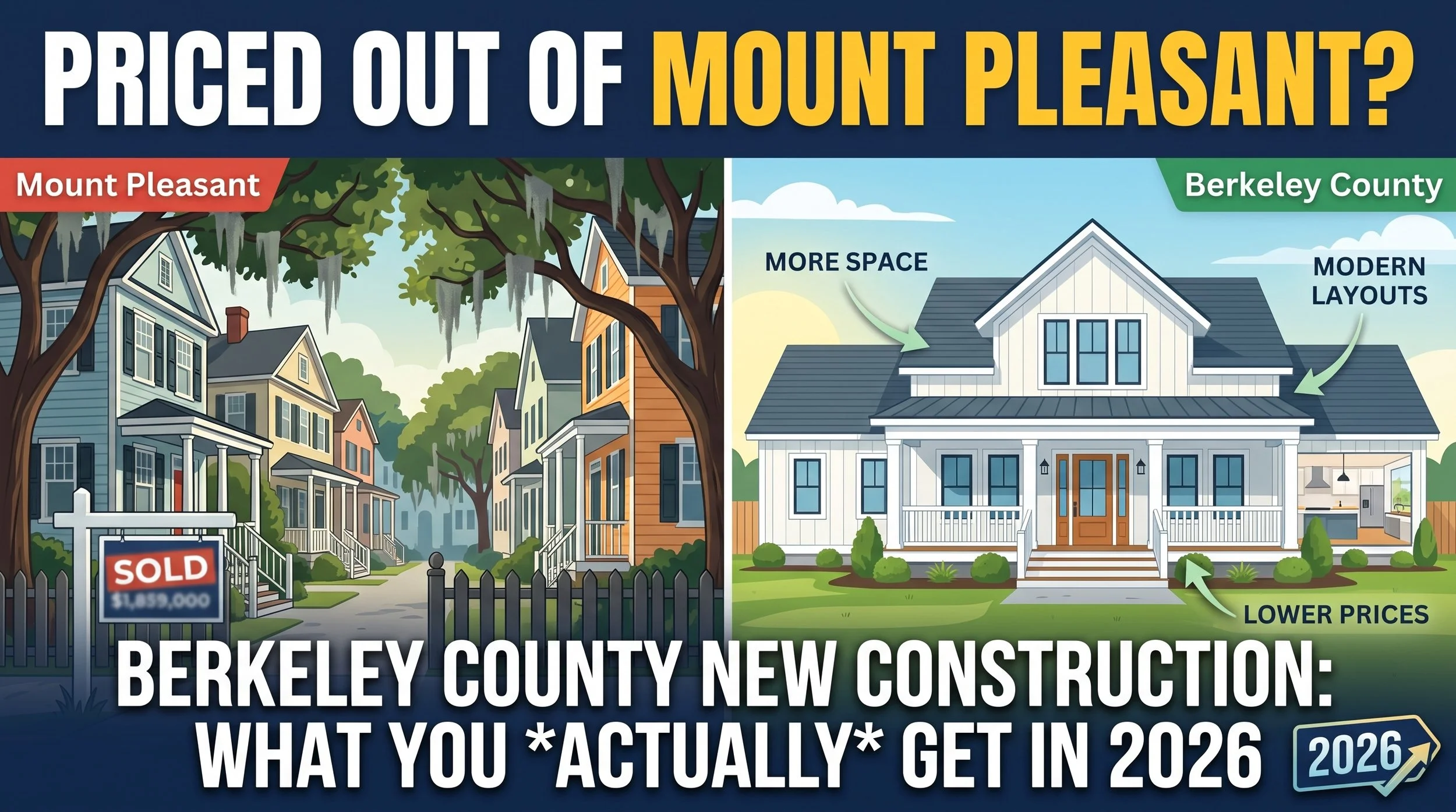
The conversation happens in my truck almost every week. A buyer relocating to Charleston has spent two months touring Mount Pleasant, fallen for the live oaks and the short drive to Sullivan's Island, and then run the numbers on what $850,000 actually buys there. Somewhere around the third showing, they ask the question that changes the search: "What's up I-26?"
That question used to be a compromise. In 2026 it is a legitimate strategy — and the buyers who understand why are getting the best terms in the region right now.
Berkeley County's new construction corridor — Nexton, Cane Bay Plantation, and Carnes Crossroads, stretching from Summerville toward Moncks Corner — is where much of the Lowcountry's new-home inventory is being built. It is also where builder incentives are most aggressive, where financing is meaningfully cheaper than what a resale buyer can get, and where the tradeoffs are real enough that you need to walk in with your eyes open.
This is not about settling. It is about knowing precisely what you are buying, what you are giving up, and what the next decade of growth does to your equity.
The Market Right Now: Cheap Money Is Sitting Inside New Construction
Freddie Mac's Primary Mortgage Market Survey put the 30-year fixed at 6.65% for the week of August 20, 2026 — down from 6.67% the prior week, the second consecutive weekly decline, and modestly above the 6.58% average of a year ago. The 15-year averaged 5.95%. Rates are drifting, not breaking.
The number that matters more for anyone shopping the Berkeley County corridor is a different one. Rate-lock data shows that borrowers using homebuilder-affiliated lenders are locking 30-year loans at a weighted average near 5.23% — roughly 137 basis points below the 6.6% average among non-builder lenders. That gap is not a marketing headline. It is the effect of forward commitments and permanent buydowns that national builders have pre-purchased on standing inventory.
NAHB data shows roughly two-thirds of builders offered some form of incentive in August, the highest share in at least five years, with temporary and permanent rate buydowns the most common tool. Builders would rather buy down your rate than cut the sticker price, because a public price reduction damages every remaining home in the community.
Meanwhile, the broader Charleston market is flat and orderly. The Charleston Trident MLS reported a median sales price of $430,000, up 1.8% year over year, with single-family homes at $460,000, up 2.2%. Homes in the $500,001–$750,000 band are moving fastest at roughly 46 days. That is a normalized market — not a distressed one, and not a frenzy.
What the Corridor Actually Costs Compared to East Cooper
Here is the arithmetic that pulls buyers north.
Mount Pleasant: median home price in the range of $838,000 to $855,000, up roughly 1% year over year.
Summerville: median around $400,000 to $410,000, essentially flat to slightly down year over year.
Berkeley County overall: median near $400,000, up about 2.5%.
Mount Pleasant is running at roughly double the Berkeley County median. On a monthly payment basis, the spread widens further once you layer in a builder buydown. A $650,000 new build at 5.25% carries a lower principal-and-interest payment than a $520,000 resale at 6.65% — and the new build comes with a warranty, current wind-and-hurricane code compliance, and no deferred maintenance.
The homes themselves are not entry-level product anymore. Nexton has drawn Pulte, Toll Brothers, and David Weekley across townhomes through substantial single-family. Cane Bay Plantation is anchored by Lennar, K. Hovnanian, and D.R. Horton at higher volume and tighter price points. Carnes Crossroads is built around a town-center concept with a more curated, walkable plan and pricing that reflects it. You can spend $380,000 or $1.1 million inside this corridor depending on which gate you drive through.
How to Evaluate a Berkeley County New Construction Purchase
1. Price the incentive, not the discount
Ask the sales agent for the lender term sheet, not the flyer. You want the note rate, whether the buydown is permanent or temporary (a 2-1 buydown expires; a permanent buydown does not), the lender credit dollar amount, and what happens to that credit if you finance elsewhere. Then have an outside lender quote the same loan so you can value the incentive in dollars rather than adjectives.
2. Read the CDD, POA, and special tax district language
Master-planned communities in this corridor commonly carry amenity assessments and, in some cases, special district financing that shows up on the tax bill rather than the HOA statement. Two homes at identical prices in adjacent communities can differ by $150 or more per month in carrying cost. This belongs in your underwriting, not in a surprise at closing.
3. Verify the lot, not just the plan
Much of this corridor was pine plantation and low-lying woodland. Pull the flood zone determination on the specific lot, look at where stormwater ponds sit relative to your rear property line, and ask what the finished floor elevation is. Berkeley County drains slowly. A home three lots away can be in a different situation entirely.
4. Confirm the build-out schedule around you
Ask for the phasing map. If you are buying in Phase 4 of a nine-phase community, you are living beside active construction for years. That is not a reason to walk — early-phase pricing is usually the best pricing — but it should be a negotiating input.
5. Use your own inspector at both stages
Pre-drywall and final. Builder warranties are real, but the leverage to get something corrected is highest before the closing table, not after. If you are new to the market, our guide for out-of-state buyers coming to Charleston covers the local diligence items that surprise relocating families.
Buyer and Seller Strategy for the Rest of 2026
If you are buying: target standing inventory over to-be-built. Builders carry the heaviest incentives on completed spec homes because those homes are sitting on their balance sheet accruing interest. Ask specifically which homes are past their projected close date — that is where the buydown money concentrates. And bring representation. Builder sales agents work for the builder; your agent costs you nothing at the closing table and negotiates the incentive package, the lot premium, and the design-center allowance as one deal rather than three.
If you are selling a resale home in this corridor: you are competing against a builder who can effectively hand a buyer a 5.25% rate. You cannot match that with fresh paint. You can match it with a seller-funded permanent buydown, which is usually cheaper than the price reduction you would otherwise take. Price at the market, then put your concession where the buyer feels it monthly.
If you are considering land or a custom build instead: the economics north of the Ashley remain compelling, and we covered the mechanics in detail in our guide to buying land in Berkeley County. Custom construction costs are also worth benchmarking against production pricing before you commit — see our 2026 Charleston new construction cost guide.
Local Market Context: What a Decade of Growth Does to This Corridor
Berkeley County's population is estimated near 283,340 in 2026, growing roughly 3.2% year over year and ranking second in South Carolina for growth. Nexton, Cane Bay, and Carnes Crossroads together are projected to hold somewhere between 50,000 and 75,000 residents at full build-out over the next decade.
That is the opportunity and the risk in the same sentence. The opportunity is that commercial, medical, and employment infrastructure follows rooftops, and the households buying here today are buying ahead of that. The risk, documented at length by local reporting, is that roads and public services have lagged the housing. I-26 and the surface network feeding these communities were not designed for this volume, and the commute to downtown Charleston or Mount Pleasant is materially longer than the map suggests during peak hours.
Drive your actual commute at 7:30 a.m. on a Tuesday before you write an offer — not on a Saturday afternoon. That single hour of diligence has changed more buying decisions than any spreadsheet I have built for a client.
For those weighing East Cooper against the corridor, our Mount Pleasant buyer guide lays out where breathing room has opened up closer to the water.
Frequently Asked Questions
Is Nexton or Cane Bay better for resale value?
Nexton has generally commanded stronger price-per-square-foot and a broader builder mix, including move-up product. Cane Bay is higher volume at tighter price points, which means more comparable inventory competing with you at resale. Neither is wrong — but if resale liquidity is a priority, favor the community with fewer identical floor plans.
How much are builder incentives worth in Berkeley County right now?
It varies by builder and by home, but the meaningful value is usually in financing rather than price. A permanent rate buydown from roughly 6.65% to the low-5s on a $500,000 loan is worth well over $100,000 in interest across the life of the loan. Always ask for the incentive quantified in dollars.
Do I need a real estate agent to buy new construction?
Yes — and it does not increase your cost. Builders budget for cooperating broker compensation. Without representation, you negotiate the price, the lot premium, the design allowances, and the lender credit against a professional who does this daily and answers to the builder.
Are these homes in a flood zone?
Some lots are, some are not, and it varies within a single community. Get the flood determination on the specific address, confirm the finished floor elevation, and price flood insurance before your due diligence period ends rather than after.
How does the commute to downtown Charleston really work?
Plan on 45 to 70 minutes to the peninsula in morning traffic depending on which community and which entrance you use, and longer to Mount Pleasant. Off-peak is dramatically better. Test it yourself first.
Should I buy new construction or an existing home in 2026?
If payment matters more than location, new construction currently wins on financing. If proximity to the water, the peninsula, or established schools matters more, resale closer in is usually the better long-term hold. The right answer depends on how long you plan to own it.
Let's Talk About Your Charleston Move
Looking to buy, build, or invest in Charleston real estate? I'm Chris Eller, Broker Associate with The Cassina Group and a luxury real estate developer specializing in new construction and coastal properties across Charleston and the barrier islands. Call or text: 843-343-3359 | Email: Chris@TheCassinaGroup.com | Website: ChrisEllerRealEstate.com. If you're considering buying, selling, or building in Charleston or anywhere in the Lowcountry, reach out anytime for expert guidance.
