

Buying the Lot Was the Easy Part: What It Really Costs to Build a Custom Home on James Island in 2026
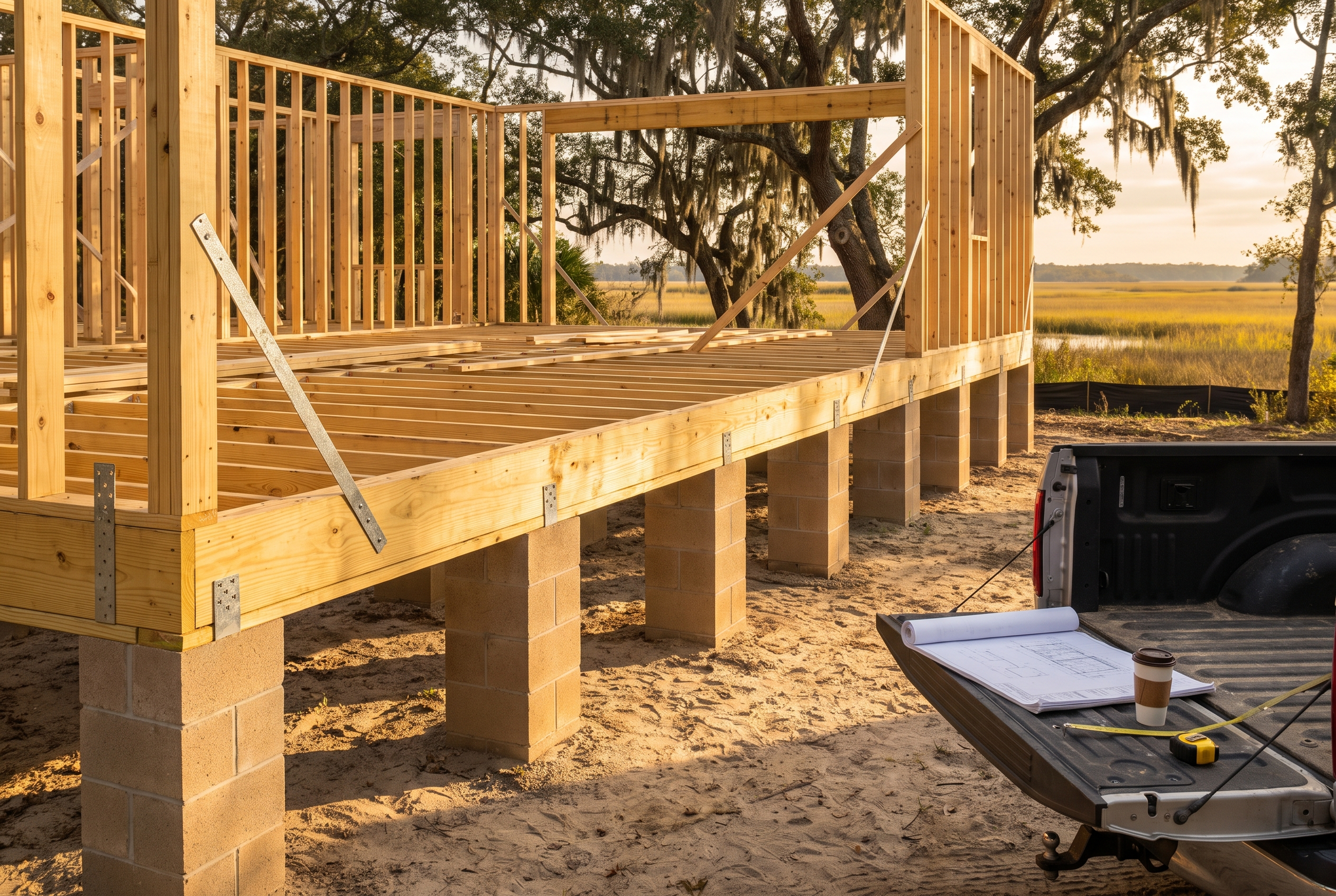
Every few weeks I have the same conversation. A buyer closes on a James Island lot — an older ranch on a half-acre off Fort Johnson, a cleared parcel near Riverland Terrace, something with oaks and a view of the marsh at the back. They are thrilled. Then they call three builders, get three numbers that look nothing alike, and the excitement turns into confusion.
The confusion is almost always caused by the same thing: everyone is quoting a price per square foot, and price per square foot is the least reliable number in coastal construction. It describes the house. It says nothing about the ground the house has to stand on, the elevation it has to reach, the wind load it has to resist, or the eighteen months of carrying costs between closing on dirt and moving in.
On James Island, the site is frequently the variable that decides whether a project pencils. Two lots four hundred feet apart can differ by six figures in cost to build on, and nothing in the listing photos tells you which is which. Here is where the money actually goes on a Charleston build in 2026 — what is fixed, what is negotiable, and what to verify before you write the check on the land.
Why More James Island Buyers Are Choosing to Build
The Charleston market is not tight the way it was three years ago, but it is not loose either. Per the Charleston Trident Association of Realtors, as of July 2026 the regional median sales price was $449,918, up 4.6% year over year, with inventory at 5,697 units and 3.6 months of supply. Homes were averaging 47 days on market and selling at 96.0% of list price.
Read past the numbers and the story is this: there is more to choose from than there was, but on James Island the specific thing buyers want — a well-built, elevated home with real outdoor space and modern systems — barely exists in resale. Most of the island's housing stock predates current flood and wind standards. Buyers who want that house are increasingly deciding to build it.
Financing has stopped being the swing factor it was. Per Freddie Mac's Primary Mortgage Market Survey, as of August 27, 2026 the 30-year fixed averaged 6.66%, essentially flat from 6.65% the prior week and up from 6.56% a year earlier. Rates are not falling, but they have stopped surprising people. Construction cost is where the volatility moved.
Where the Money Actually Goes on a James Island Build
1. The vertical cost — what most builders are quoting you
This is the house itself: framing, roof, mechanicals, finishes. Per Baldwin Builders' 2026 coastal South Carolina analysis, standard construction runs roughly $175–$225 per square foot, mid-range $225–$300, and high-end work $300 and up. On a 3,000-square-foot home that is a spread of more than half a million dollars, driven almost entirely by specification level — millwork, appliances, stone, window packages.
Two things are pushing that range upward in 2026. Per NAHB, softwood lumber from Canada now carries roughly 45% in combined tariffs, steel and aluminum carry a 50% Section 232 tariff, and cabinets and vanities carry 25% through January 1, 2027. More than 60% of surveyed builders report higher costs as a result, with NAHB's April 2025 estimate putting the typical tariff effect near $10,900 per home. Independently, per Tax Credit Advisor's Q3 2026 outlook, a reasonable national escalation baseline is 4–6% annually, with tariff-exposed and labor-constrained trades running higher.
2. The coastal premium — non-negotiable, and frequently underquoted
Building here costs 15–30% more than building inland, per Baldwin Builders, and the components are specific rather than vague:
Elevated foundation. Pilings, block piers, or raised slab — $8,000 to $40,000 and up depending on required height.
Impact-rated windows and doors. 130-mph-rated units cost 30–50% more than standard, adding $15,000–$35,000 on a typical home.
Wind-resistant roofing. $5–$8 per square foot for architectural shingle, $12–$18 for standing-seam metal.
Salt-air specification. Stainless fasteners, fiber cement, composite trim — $8,000 to $20,000 above inland standards.
None of this is optional and none of it is where you value-engineer. Cut here and you buy a maintenance problem and an insurance problem simultaneously.
3. The site and permitting stack — where James Island budgets break
This is the category buyers never see coming, and it is entirely site-specific. Demolition. Tree survey and mitigation for grand trees — James Island is full of them, and a protected live oak in the wrong place can move a footprint or add real cost. Stormwater and grading. Septic-to-sewer connection where it applies. Utility runs. Survey, geotechnical, architecture, engineering, and permit fees. Construction loan interest across the build.
Flood zone status sits on top of all of it. Charleston requires new homes in a Special Flood Hazard Area to be elevated above base flood elevation with freeboard — commonly two feet — and requires an elevation certificate at permitting. If you are renovating rather than rebuilding, the substantial improvement rule matters enormously: once your project exceeds 50% of the structure's value, the entire building must be brought to current new-construction standards. That threshold is why a lot of "we'll just remodel it" projects become teardowns halfway through design.
How to Budget a Build So It Actually Holds
Make the land contract earn its due diligence period. Before you close on a James Island lot, pull the flood zone and base flood elevation, order a tree survey, and get a preliminary opinion on stormwater and septic. This costs a few thousand dollars and routinely saves six figures. A lot that requires an extra four feet of elevation and the removal of two protected trees is a different asset than the one next door, and the price should reflect that.
Budget the site before you budget the house. Establish your all-in number, subtract land, subtract a realistic site and permitting figure, subtract carrying costs, and only then decide what square footage and specification level the remainder supports. Buyers who do it in the opposite order design a house they cannot afford to put on the ground.
Understand what your contract does to risk. Fixed-price puts escalation risk on the builder, who prices it into the number. Cost-plus gives you visibility and captures savings, but you carry the escalation. Neither is automatically better. What matters is that allowances are realistic — underfunded allowances are how a fixed-price contract quietly becomes a cost-plus one through change orders.
Carry a real contingency. Five percent is optimistic in this environment. Ten percent is defensible. On a site with unknowns — old fill, drainage questions, an unresolved tree — carry more.
Get your insurance number early. Wind, hail, and flood coverage on the coast has moved sharply and is a permanent line in the carrying cost of the finished home. Price it during design, not at closing.
James Island in Context
What makes James Island compelling for a build is position. You are minutes from downtown Charleston across the Ashley, minutes from Folly Beach in the other direction, on an island with mature tree canopy, deep-water creeks, and a genuine neighborhood fabric rather than a subdivision grid. That combination does not exist anywhere else in the county at this price point.
Regionally, single-family median price sat at $480,000 at mid-year 2026, up 1.1% year over year, per Charleston Home's mid-year analysis — modest appreciation, not a surge. That matters for build economics. In a 12% appreciation market, cost overruns get absorbed. At 1–4%, they do not. Margin has to be created at acquisition and protected through execution, which is why diligence on the lot is worth more than any negotiation on the house.
One scheduling note: Charleston permitting rewards complete submittals. Most delay accumulates in resubmittal cycles, not technical review, and where Board of Architectural Review approval applies the board meets twice monthly — each incomplete package costs a full cycle.
Frequently Asked Questions
How much does it cost to build a custom home on James Island?
Plan on roughly $225–$300 per square foot for mid-range construction and $300+ for high-end, per Baldwin Builders' 2026 coastal South Carolina data — then add site work, elevation, permitting, and carrying costs on top. The site stack varies enormously by lot and is the number to nail down first.
Is it cheaper to buy an existing James Island home and renovate?
Sometimes, but check the substantial improvement rule first. If your renovation exceeds 50% of the structure's value, the entire home must meet current new-construction flood standards — which usually means elevating it. At that point, building new is often the better economics and always the better house.
How long does a custom build take in Charleston?
Design and permitting typically run several months before construction begins, and coastal builds take longer than inland equivalents. Budget carrying costs for the full timeline, not just the construction phase, and assume BAR review adds cycles where it applies.
What does flood zone status do to my build cost?
It sets your required elevation. Homes in a Special Flood Hazard Area must be elevated above base flood elevation with freeboard, which drives foundation cost, access design, and insurance premiums. Confirm the zone and base flood elevation before you close on land.
Are construction costs still rising in 2026?
Yes, though unevenly. A 4–6% annual escalation baseline is reasonable per Tax Credit Advisor's Q3 2026 outlook, with tariff-exposed materials — lumber, steel, cabinetry — running higher. Treat escalation trade by trade, not as one blanket percentage.
Should I use a fixed-price or cost-plus contract?
Fixed-price shifts escalation risk to the builder and prices it in. Cost-plus gives you transparency and captures savings but leaves the risk with you. The more important question is whether the allowances are honest — that determines your real exposure under either structure.
Let's Talk About Your Charleston Build
Looking to buy, build, or invest in Charleston real estate? I'm Chris Eller, Broker Associate with The Cassina Group and a luxury real estate developer specializing in new construction and coastal properties across Charleston and the barrier islands.
Call or Text: 843-343-3359 | Email: Chris@TheCassinaGroup.com | Website: ChrisEllerRealEstate.com
If you're considering buying, selling, or building in Charleston or anywhere in the Lowcountry, reach out anytime for expert guidance.
