

Building a New Home on James Island? The Permit Path Decides Your Schedule Before Design Does
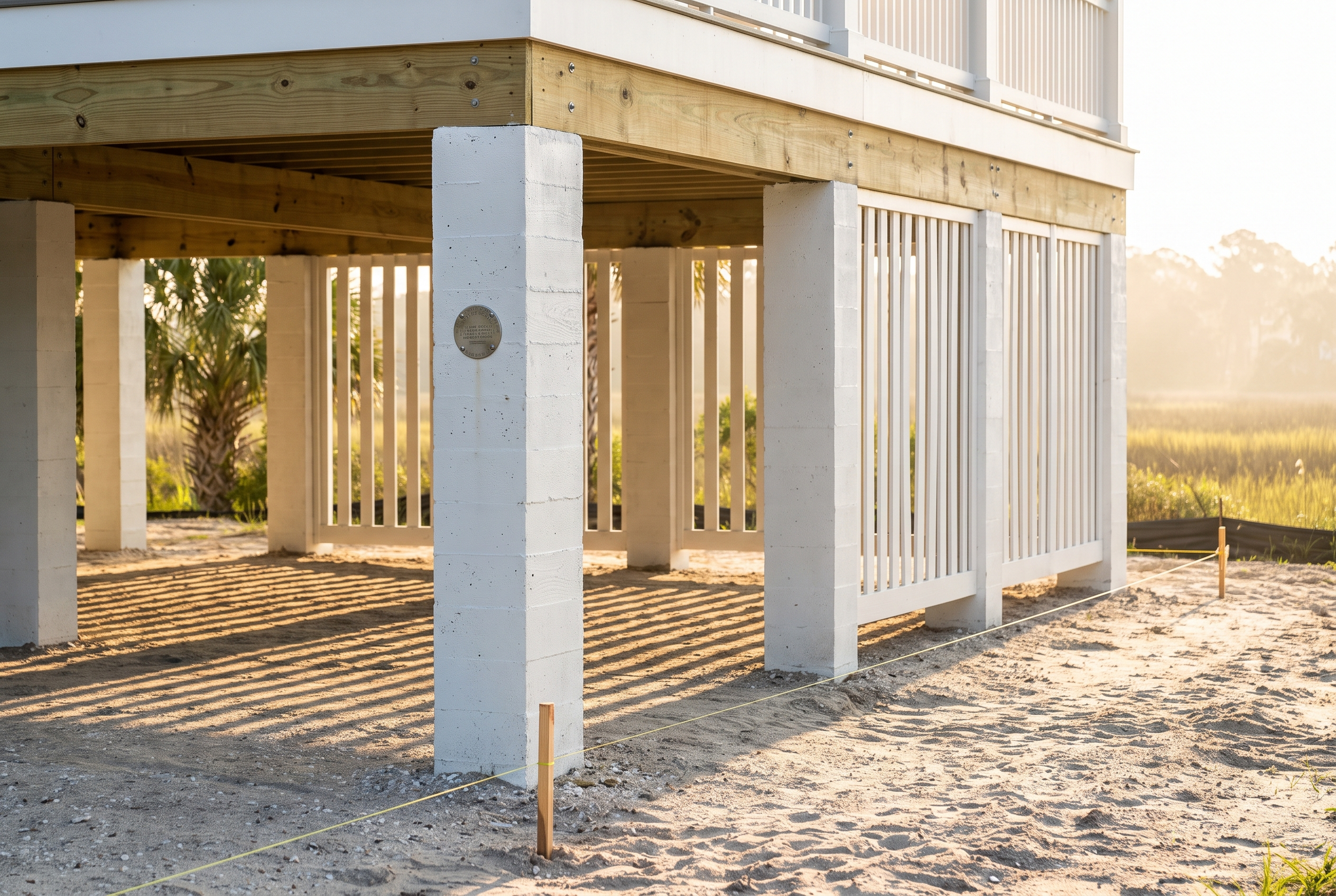
Here is the short answer, because it is the question we get asked most: on James Island, your build schedule is set by three approvals — stormwater and drainage, tree protection, and flood elevation — and all three are governed by the dirt, not the drawings. Most of the delay we see does not happen inside plan review. It happens before submittal, while somebody scrambles to produce a survey, a tree affidavit or a drainage plan that should have been ordered during due diligence. Sort those out before you finalize a floor plan and a James Island build moves. Skip them and you will redesign.
Key Takeaways
Jurisdiction first. James Island parcels sit in the Town of James Island, the City of Charleston, or unincorporated Charleston County — and the rules differ by parcel, not by street.
Elevation is a design input, not a detail. City of Charleston parcels require two feet of freeboard above base flood elevation for new construction, and slab-on-grade is off the table for single-family homes in the 100-year floodplain.
Trees and drainage decide your footprint. Tree affidavits and stormwater materials are submittal requirements, not afterthoughts.
Order matters. Town zoning approval comes before the county building permit — running them out of sequence costs weeks.
Delay is expensive right now. At today's rates, every month of carry on a median-priced Charleston basis runs roughly $2,500 in interest alone.
What James Island Buyers and Builders Are Running Into Right Now
The Charleston market has loosened just enough to put teardown and infill lots back in play. Across the Charleston Trident region in August 2026, inventory reached 5,593 homes and days on market stretched to 51, up 6.3% year over year, while the median sales price held at $431,500 (per Charleston Trident Association of Realtors market data, August 2026). Sellers are negotiating, and buyers have room to inspect.
Financing is the offsetting pressure. The 30-year fixed averaged 7.03% in the week ending September 24, 2026, up from 6.95% the prior week and 6.30% a year earlier (per Freddie Mac's Primary Mortgage Market Survey, September 2026). Construction loans price off that same environment. So the deal math has shifted: you can negotiate the lot, but not the calendar. Time is now the most expensive line item on a James Island build, and permitting is where it disappears.
The city has actually gotten faster at the review itself. Charleston cut its Technical Review Committee backlog from 67 cases in early 2024 to five by 2026 and moved roughly 80% of permit work online (per Permittable's Charleston permit guide, 2026). Which tells you something important: if your project is stuck, it is almost certainly stuck on your side of the counter.
The Three-Gate Rule for Lowcountry Lots
We use a simple framework on every coastal lot we evaluate, and it has saved clients more money than any value-engineering exercise we have ever run. We call it the Three-Gate Rule. Every Lowcountry lot has to clear three gates, and they have to be cleared in this order, because each one constrains the next.
Gate 1 — Dirt: what the lot will let you disturb
Stormwater and trees. On James Island, a residential submittal package expects a site plan, a tree affidavit, stormwater materials where applicable, and a drainage plan (per the James Island permit guide, 2026). A grand tree in the wrong spot, or a low corner that has to hold water, will move your building envelope ten or fifteen feet. That is a different house. Order the boundary and topographic survey and walk the lot with an arborist during due diligence, not after closing.
Gate 2 — Height: what the flood map requires
For parcels under City of Charleston jurisdiction, new construction must be elevated two feet above base flood elevation, and since January 1, 2024, single-family homes in the 100-year floodplain can no longer use slab-on-grade foundations. Coastal A Zone parcels carry additional flood design requirements under the 2021 South Carolina Building Code (per the City of Charleston Floodplain Development standards). Pull the flood zone and BFE before you commission a design. Elevation drives foundation type, stair runs, garage placement, driveway slope and, on a renovation, whether the 50% substantial improvement rule turns your remodel into a new build.
Gate 3 — Paper: who approves what, and in what order
This is the gate that surprises people. James Island is not one jurisdiction. For Town of James Island parcels, the town issues the zoning permit and Charleston County Building Inspection Services issues the building permit through the county portal — town first, county second, with water and sewer fees paid before issuance. Confirm your parcel's jurisdiction before you assume any of the above applies to it.
GateWhat it governsConfirm it by1 — DirtStormwater, drainage, tree protection, buildable envelopeDue diligence, before closing2 — HeightFlood zone, BFE, freeboard, foundation typeBefore schematic design3 — PaperJurisdiction, review sequence, utility feesBefore submittal
Citation & Key Stat
At a 7.03% 30-year fixed rate (Freddie Mac PMMS, September 24, 2026) applied to the Charleston Trident median sales price of $431,500 (CTAR, August 2026), carrying cost runs roughly$2,528 per month in interest alone— meaning a 90-day permitting delay costs about$7,584 before a single board is hung. For context, regulatory requirements already add $131,734 to the average new home, or 26.4% of its sales price, up more than 40% in five years (per NAHB, June 2026). Calculation by Chris Eller, The Cassina Group.
What to Actually Do Right Now
If you are buying a lot: write your due diligence period around Gate 1 and Gate 2, not around a generic inspection window. Thirty days is thin on a marsh-adjacent parcel. Use the time to pull the flood zone and BFE, get a topographic survey, identify protected trees, and confirm jurisdiction. If the seller will not give you the room, that tells you something about the lot.
If you already own and are ready to build: stop designing and go get the data. A conceptual set drawn before the survey and flood determination is a set you will pay to redraw. The cheapest week in any project is the one spent confirming what the lot allows.
If you are renovating: get a defensible cost-to-value opinion before you swing a hammer. Cross the 50% threshold and the entire structure has to meet current flood standards — a renovation budget becomes a lift-and-rebuild budget overnight. That is a conversation to have with your builder and your floodplain administrator early.
How This Fits the Wider Charleston Picture
James Island is where a lot of Charleston buyers land when Sullivan's Island and Isle of Palms price them out but they still want water, oaks and a ten-minute drive downtown. That demand is durable. What has changed is that the entitlement and elevation burden on a coastal lot is now a material share of the project cost, not a rounding error — NAHB puts land development regulation alone at $46,795 per home nationally, with construction-phase regulation at $84,939 (June 2026). Charleston's coastal overlay sits on top of that baseline.
The practical effect: well-vetted James Island lots with clean drainage, a clear building envelope and a known elevation trade at a real premium to raw acreage, and they deserve it. The discount lot is usually discounted for a reason, and that reason is almost always Gate 1. Finished new construction here holds value well against resale inventory — exactly what you would expect when producing new supply keeps getting harder.
Frequently Asked Questions
How long does it take to get a building permit on James Island?
Neither the town nor the county publishes a fixed turnaround for full residential plan review. Budget realistically and understand that most delay accumulates before technical review — in completeness and resubmittal cycles — rather than inside it. A complete first submittal is the single biggest schedule lever you control.
Do I need a stormwater permit to build a single home on James Island?
It depends on your parcel and how much you disturb, but stormwater materials and a drainage plan are part of the standard residential submittal expectation. Assume you will need them and confirm the threshold with the town and Charleston County Public Works before you design the site.
How high does a new home have to be built on James Island?
It depends on jurisdiction and flood zone. On City of Charleston parcels, new construction must sit two feet above base flood elevation. Pull your parcel's specific flood zone and BFE — never rely on a neighbor's number.
Can I still build a slab-on-grade house in a Charleston flood zone?
Not for a single-family home in the 100-year floodplain under City of Charleston rules, effective January 1, 2024. Plan on an elevated foundation and price it accordingly.
What is the 50% rule and why does it matter on a renovation?
If improvement or repair costs reach 50% of the structure's assessed value — including cumulative work within a one-year period — the building must meet current new-construction flood standards. It is the most common budget surprise we see on older James Island homes. Confirm valuation and scope with your floodplain administrator early; your builder can help you structure the work, but the determination is theirs.
Is a tree survey really necessary before I buy?
On a wooded James Island lot, yes. Tree documentation is a submittal requirement, and a protected tree in the middle of your buildable area is a design constraint you want to price during due diligence, not discover at permitting.
Let's Talk About Your Lot
Looking to buy, build, or invest in Charleston real estate? I'm Chris Eller, Broker Associate with The Cassina Group and a luxury real estate developer specializing in new construction and coastal properties across Charleston and the barrier islands.
Call or text: 843-343-3359
Email: Chris@TheCassinaGroup.com
Website: ChrisEllerRealEstate.com
If you're considering buying, selling, or building in Charleston or anywhere in the Lowcountry, reach out anytime for expert guidance.
This article is general information about the development process and is not legal, tax, engineering or lending advice. Flood, zoning and permitting determinations are parcel-specific — confirm requirements with your floodplain administrator, licensed engineer and the applicable jurisdiction.
