

Your Offer Was Accepted. Then the Insurance Quote Came In: The Real Story on Charleston Coastal Home Insurance Costs
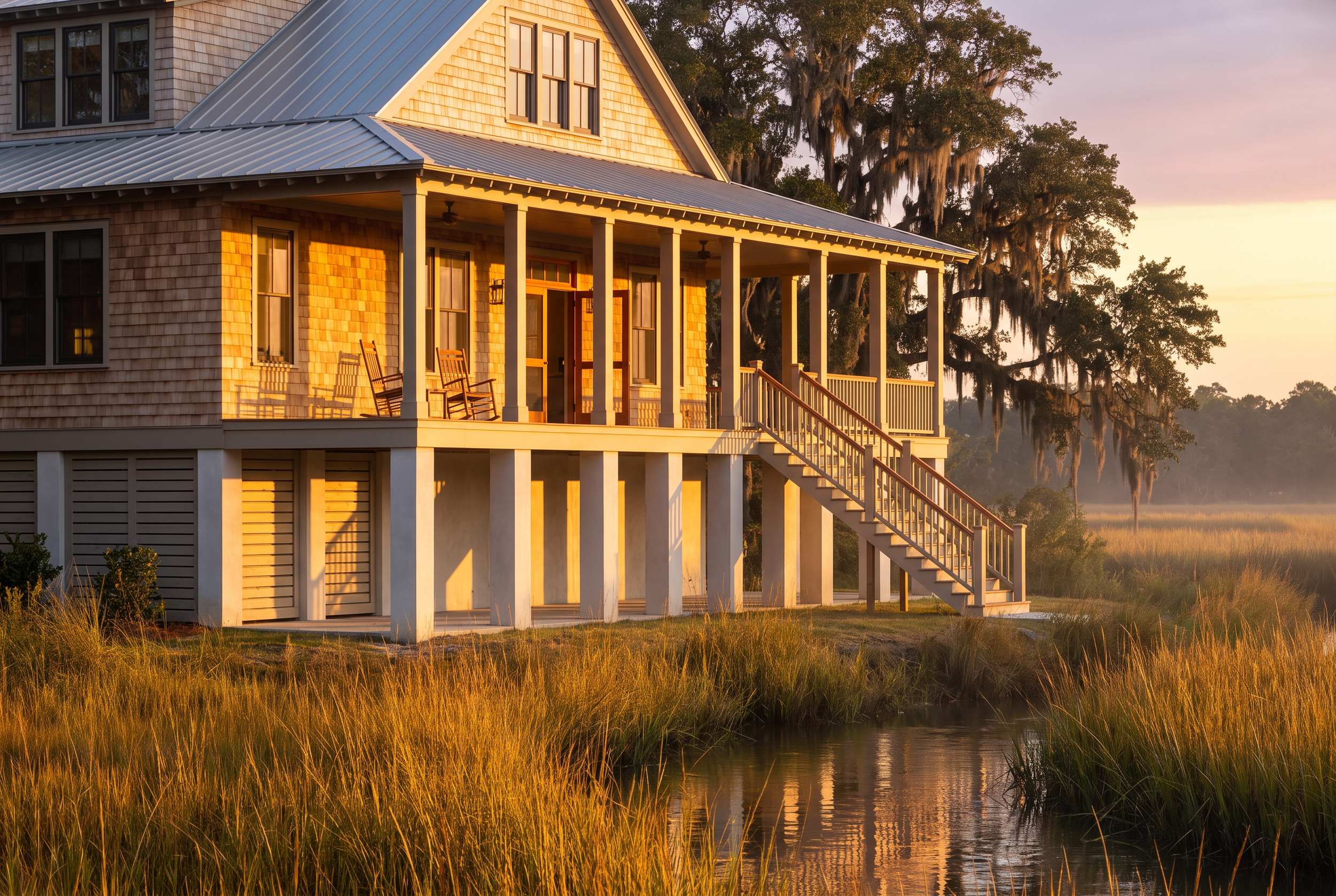
Here is a conversation we are having almost every week right now. It rarely happens at the beginning of a deal — it happens on day nine of due diligence.
A buyer finds the house — Isle of Palms, the back side of Sullivan's, a marsh-front lot in Mount Pleasant. They ran the numbers before writing the offer, and the payment worked. Then the insurance quotes come back, the wind-and-hail number is nothing like the placeholder their lender used, and the monthly is four figures higher than the spreadsheet said. Now the deal is being re-litigated with eight days on the clock.
That is not a rate problem. Rates have been cooperating — the 30-year fixed averaged 6.65% in the week of August 20, per Freddie Mac's Primary Mortgage Market Survey, its second straight weekly decline, as of August 2026. The problem is that the cost of carrying a coastal home here has moved faster than the cost of financing one, and most buyers still underwrite the purchase like it's 2019.
■ INSERT IMAGE HERE — HERO
File: charleston-coastal-home-insurance-costs.jpg
Delete this box after you drop the Squarespace image block in.
Why the Carrying Cost Moved While Nobody Was Watching
Three separate lines on your closing statement have all been moving the same direction at once, and buyers tend to look at them one at a time.
Wind and hail. On the barrier islands and across much of the coastal zone, this is carved out of the standard homeowners policy and written separately — often through the South Carolina Wind and Hail Underwriting Association or a surplus-lines carrier. It is frequently the largest line item, and the one lender estimates get most wrong.
Flood. FEMA's Risk Rating 2.0, phased in from 2021, replaced flood-zone pricing with property-specific pricing: elevation, distance to water, replacement cost. South Carolina's average NFIP premium rose from roughly $695 in 2024 to about $743 in 2025, per FEMA data reported by InsuranceNewsNet, as of 2026 — but that statewide average is close to meaningless on a barrier island. In the same reporting, Pawleys Island averaged $4,199, and individual coastal owners described premiums that had roughly doubled since 2023. Increases are capped annually but keep climbing toward the full-risk rate, so today's quote is not the number you'll pay in year seven.
Homeowners. A July 2026 report from the Coalition for an Insurable Future, covered by Live 5 News, projected South Carolina could see the second-highest homeowners premium increases in the country over the next decade, using FEMA's risk index as its baseline. Argue with the projection if you like; the direction isn't in dispute.
Meanwhile the market underneath it has stayed strong, which is what makes this a budgeting problem rather than an academic one. Charleston's regional median sale price ran $449,990 through the first five months of 2026, up 2.3% year over year, per a mid-year analysis published by Charleston Home in June 2026. On the islands it's a different sport: Sullivan's Island posted a $4,750,000 median, Isle of Palms $2,195,000 with sales up 32.4%, Daniel Island $1,625,000 with sales up 31.7%. Demand hasn't blinked — the carrying cost just got heavier underneath it.
How to Price a Charleston Coastal Home Before You Write the Offer
Started early, this takes about 48 hours.
1. Pull the flood zone and the elevation certificate first
Find out what zone the property sits in and whether an elevation certificate exists. In a VE or AE zone, the difference between a home at base flood elevation and one three feet above it is not a rounding error — it is often the difference between a deal that works and one that doesn't. If the seller has a certificate, get it day one; if not, budget for a surveyor. On an older Isle of Palms or James Island property, that document matters more to your underwriting than the home inspection.
2. Get a real wind-and-hail quote, not the lender's estimate
Lender insurance estimates are generic and, on the coast, frequently wrong. Call a local independent agent who writes barrier-island business every week and get a bindable quote on the actual address — during due diligence, not after. Someone who works Sullivan's and Isle of Palms daily prices it in a day.
3. Ask what the roof is and when it went on
Roof age and construction drive coastal premiums harder than almost anything else on the structure. A twelve-year-old three-tab roof and a two-year-old sealed-deck roof with proper roof-to-wall connectors quote very differently on the same street — which brings us to the most useful thing in this article.
■ INSERT IMAGE HERE — MID-ARTICLE
File: charleston-fortified-roof-wind-mitigation-coastal-construction.jpg
Delete this box after you drop the Squarespace image block in.
The Lever Most Owners Never Pull: Mitigation Credits
South Carolina requires insurers to offer premium discounts and credits for qualifying wind-mitigation improvements — a framework in place since the Department of Insurance issued its implementation bulletin in 2007. Discounts vary by carrier, but they're real, and a lot of coastal owners aren't claiming them because nobody ever inspected for them.
The improvements that move the needle are the ones you'd expect from anyone who has actually built on the coast:
Strengthened roof deck attachment — ring-shank nailing in the correct pattern
A secondary water barrier: sealed deck seams that keep water out even if shingles come off
Reinforced roof-to-wall connections — straps and clips, not toe-nailing
Gable-end bracing
Impact-rated windows, doors, and garage doors, or approved shutters and protective barriers
Worth knowing before your next roof: the state will help pay for it. The SC Safe Home mitigation grant program, run by the South Carolina Department of Insurance, offers up to $7,500 for resilient mitigation ($6,000 matching), up to $5,000 for sustainable mitigation ($4,000 matching), and up to $3,000 for hurricane shutters and protective barriers, per program materials as of 2026. Eligibility is income-based and adjusted for household size. Funds are limited and application windows close — check it when you shop the roof, not after.
The sequence: get a wind-mitigation inspection, find out which credits you already qualify for and aren't receiving, then decide whether upgrading to a fortified standard pays for itself over your hold period. Often it does. Either way it should be a math problem, not a guess.
What This Means If You're Buying, Selling, or Building
Buying
Move insurance into the pre-approval conversation. Ask your lender what hazard number they used, get the real quote, re-run the payment. If you're stretching to a price point, the honest version is that on the islands insurance may be the constraint on what you can carry — not the rate. Learn that in week one, not week three with earnest money at risk. And assume it grows, because under Risk Rating 2.0 it's designed to.
Selling
Get in front of it. Have the elevation certificate, roof documentation, and a current insurance quote in the listing file before you go live. A seller who answers "what does it cost to insure" in an hour with paperwork keeps the deal; one who takes four days and shrugs invites a re-trade. If your roof is near end of life and you're twelve months out, replacing it to a fortified standard both defends your price and lowers the buyer's carrying cost — a quantifiable argument at the table.
Building
Elevation and mitigation are cheapest at framing and most expensive as a retrofit. Charleston's floodplain ordinance requires new construction to carry a set amount of freeboard above Base Flood Elevation, and the requirement varies by zone — confirm the number for your parcel with the City of Charleston floodplain office or Charleston County Building Inspection Services before finalizing plans. Then have the conversation nobody has early enough: an extra foot or two above the minimum costs real money in piling, stair runs, and lift, and it changes the insurance picture for the life of the home. Run it as a return calculation against hold period and exit value — on a marsh-front build it frequently pencils. Same with opening protection and roof assembly.
■ INSERT IMAGE HERE — LOCAL-CONTEXT
File: isle-of-palms-sullivans-island-coastal-homes-market.jpg
Delete this box after you drop the Squarespace image block in.
The Charleston Context
None of this argues against coastal Charleston. Isle of Palms sales volume up 32.4% and Daniel Island up 31.7% through mid-2026, per that Charleston Home analysis, are not the numbers of a market people are leaving — and growth keeps pushing north and east into Berkeley County as buyers hunt land and new construction.
What's changing is who can carry what. Rising carrying cost compresses the buyer pool unevenly: it hits older, lower-elevation, older-roof inventory far harder than well-built, well-elevated, properly mitigated homes. That's an opportunity for anyone building to a higher standard, and a risk for anyone holding aging coastal inventory on the assumption the next buyer absorbs the premium without adjusting price.
The homes that hold value best on these islands over the next decade will be the ones that are cheap to insure. That's a builder's opinion as much as a broker's.
Frequently Asked Questions
How much is flood insurance on Isle of Palms or Sullivan's Island?
There's no reliable island-wide average — Risk Rating 2.0 prices each property individually on elevation, distance to water, and replacement cost. South Carolina's statewide average NFIP premium was roughly $743 in 2025 per FEMA data, but barrier-island properties commonly run multiples of that. The only accurate answer is a quote on the specific address.
Is wind and hail included in my Charleston homeowners policy?
Often not. In the coastal zone it's frequently excluded and written separately, sometimes through the South Carolina Wind and Hail Underwriting Association. Ask your agent to show homeowners, wind and hail, and flood as three separate line items so you see your true annual cost.
Can I get an insurance discount for a new roof in South Carolina?
Frequently yes. South Carolina requires insurers to offer credits for qualifying wind-mitigation features — roof deck attachment, secondary water barrier, and roof-to-wall connections are the biggest drivers. Amounts vary by carrier. A wind-mitigation inspection documents the credits, and many owners qualify for ones they aren't receiving.
What is the SC Safe Home grant and do I qualify?
A Department of Insurance program that helps fund wind-mitigation retrofits — up to $7,500 for resilient mitigation, $5,000 for sustainable mitigation, $3,000 for shutters and protective barriers, as of 2026. Eligibility is income-based and adjusted for household size. Check current status and the award estimator with the department directly; windows and funding are limited.
Let's Talk About Your Situation
Looking to buy, build, or invest in Charleston real estate? I'm Chris Eller, Broker Associate with The Cassina Group and a luxury real estate developer specializing in new construction and coastal properties across Charleston and the barrier islands.
Call or text: 843-343-3359 | Email: Chris@TheCassinaGroup.com | Website: ChrisEllerRealEstate.com
If you're considering buying, selling, or building in Charleston or anywhere in the Lowcountry, reach out anytime for expert guidance.
